5 Business Processes You Should Automate With AI

Salman
September 11, 2026
AI automation can transform repetitive business processes into intelligent workflows. Discover five areas where AI can reduce manual work, improve efficiency, and create measurable business value.
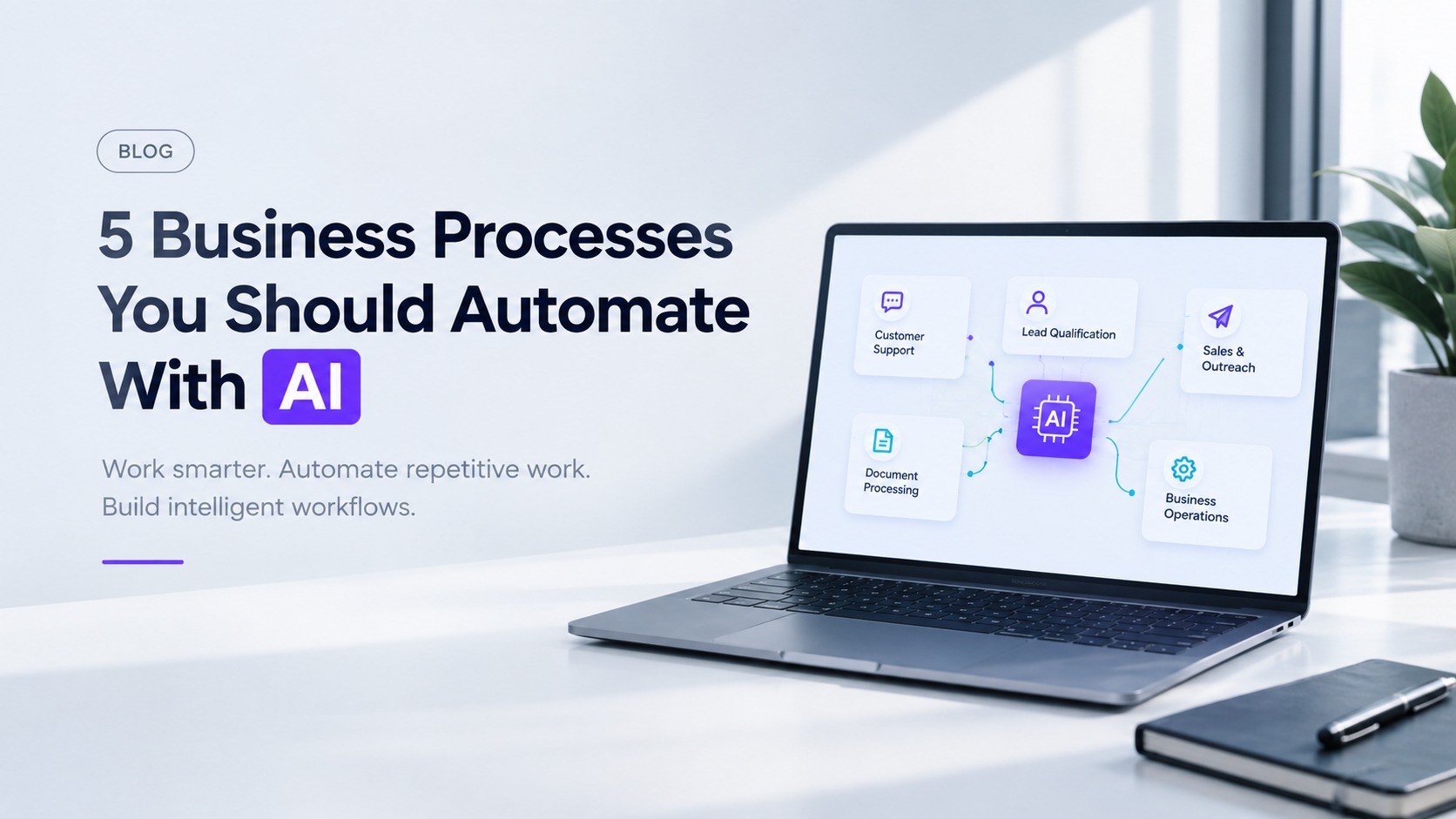
5 Business Processes You Should Automate With AI
Artificial intelligence is changing how businesses operate.
What started with AI chatbots and generative AI tools has quickly evolved into something much more powerful. Businesses can now use AI automation, AI agents, large language models, RAG systems, and intelligent workflows to handle tasks that previously required significant amounts of manual work.
But the biggest opportunity is not simply adding an AI chatbot to your website.
The real opportunity is connecting AI to the processes your business already depends on.
Think about the repetitive work happening every day:
Customer questions need answers.
Leads need to be reviewed.
Sales teams need to research prospects.
Documents need to be processed.
Internal workflows need to be managed.
These processes can consume hundreds of hours over time.
With the right AI automation strategy, many of them can become faster, more consistent, and more scalable.
Here are five business processes where AI automation can make a meaningful difference.
1. Customer Support
Customer support is one of the most obvious opportunities for AI automation.
Businesses receive repetitive questions every day about products, pricing, policies, orders, documentation, account information, and services.
A traditional support workflow often looks like:
Customer → Support Agent → Knowledge Base → Response
AI can turn this into:
Customer → AI → Knowledge Retrieval → Response → Human Escalation
An AI customer support system can understand a customer's question, retrieve relevant information from a company's knowledge base, generate a grounded response, and escalate complex situations to a human.
This is where Retrieval Augmented Generation, or RAG, becomes particularly useful.
Instead of relying entirely on what an LLM learned during training, a RAG system can retrieve relevant information from company documents, databases, product documentation, or internal knowledge before generating an answer.
What can be automated?
• Frequently asked questions
• Product and service information
• Documentation search
• Basic troubleshooting
• Order and account queries
• Ticket classification
• Support ticket routing
• Human escalation
The goal is not to replace human support.
The goal is to allow support teams to spend more time solving complex customer problems while AI handles repetitive requests.
2. Lead Qualification
Sales teams often spend significant time reviewing incoming leads and determining which prospects deserve immediate attention.
AI can automate much of this process.
A traditional workflow might require a sales representative to manually review each lead, research the company, understand the customer's requirements, and decide whether the prospect is worth pursuing.
An AI powered workflow can handle much of the initial analysis:
Lead Capture → AI Analysis → Intent Detection → Lead Scoring → CRM
An AI system can analyze information provided by a prospect and identify signals such as:
• Customer intent
• Company information
• Requirements
• Budget signals
• Product interest
• Lead quality
• Potential buying stage
The system can then assign a score and automatically send qualified leads to the appropriate sales workflow.
Why does this matter?
Sales teams should spend their time talking to promising prospects, not manually sorting every lead.
AI automation can help businesses prioritize opportunities and create faster sales workflows.
3. Sales and Outreach
Personalized sales outreach can generate better results than generic messaging, but personalization traditionally requires a lot of manual research.
A sales representative may need to:
Research a prospect.
Understand their company.
Identify relevant pain points.
Write a personalized message.
Send the outreach.
Track the response.
AI can connect these steps into one intelligent workflow:
Research → Personalization → Outreach → Follow Up → Tracking
AI agents can help research prospects, summarize relevant information, identify potential business needs, and generate personalized communication.
The system can also connect with CRM platforms, email platforms, databases, and other business tools through APIs.
AI can help automate:
• Prospect research
• Lead enrichment
• Personalized messaging
• Email generation
• Follow up sequences
• Lead segmentation
• Campaign analysis
• CRM updates
This creates an AI powered sales workflow where research, personalization, and repetitive follow up tasks can happen with significantly less manual effort.
4. Document Processing
Businesses work with enormous amounts of unstructured information.
Invoices.
Contracts.
Reports.
Applications.
Forms.
Research documents.
Customer records.
Manually extracting and organizing information from these documents can be slow and error prone.
AI can turn unstructured documents into usable business data.
A typical workflow can look like:
Documents → AI Extraction → Classification → Structured Data
Modern LLM applications can understand documents, extract relevant information, classify content, and make that information searchable.
When combined with RAG, businesses can also build systems that allow employees to ask questions about their internal documents using natural language.
For example:
"What are the payment terms in this contract?"
Instead of manually searching through dozens of pages, an AI document intelligence system can retrieve the relevant information and provide a grounded answer.
Document AI can automate:
• Information extraction
• Document classification
• Knowledge retrieval
• Contract analysis
• Data entry
• Document search
• Report processing
• Internal research
This is particularly valuable for businesses that manage large amounts of information every day.
5. Business Operations
Some of the biggest opportunities for AI automation exist inside everyday business operations.
Businesses often have workflows that depend on multiple tools and manual decisions.
For example:
Trigger → Decision → Workflow → Action
A new customer submits a form.
The system analyzes the request.
AI determines what should happen next.
The appropriate workflow starts.
The relevant tools are updated automatically.
This is where AI agents and intelligent automation become especially powerful.
Instead of simply generating text, an AI agent can reason about a task, use available tools, retrieve information, make decisions within defined permissions, and execute actions.
Business operations that can be automated include:
• Data entry
• Internal notifications
• Task assignment
• Report generation
• Workflow routing
• CRM updates
• Email processing
• Data analysis
• Internal knowledge workflows
• Repetitive administrative tasks
The result is an intelligent workflow that can operate across multiple systems instead of keeping every process dependent on manual intervention.
AI Automation Is More Than a Chatbot
One of the biggest misconceptions about business AI is that AI automation means adding a chatbot.
A chatbot is only one possible application.
Modern AI systems can combine:
LLMs + RAG + AI Agents + APIs + Business Logic + Automation
Together, these technologies can create systems that understand information, reason about tasks, retrieve knowledge, interact with software, and execute workflows.
The architecture might look like:
Data → AI → Decision → Automation → Action → Business Result
This is where AI starts becoming part of the business infrastructure rather than simply another software feature.
Where Should Your Business Start?
Not every process needs AI.
The best candidates usually have a few characteristics.
High volume
The process happens frequently and consumes significant time.
Repetitive work
Employees repeatedly perform similar steps.
Structured decisions
The process follows recognizable patterns or rules.
Large amounts of information
Employees spend significant time searching, reading, classifying, or analyzing information.
Multiple systems
The workflow requires moving information between different tools or platforms.
When these conditions exist, AI automation can potentially create significant value.
The Goal Is Business Impact
AI implementation should not start with the question:
"Where can we add AI?"
A better question is:
"Which business process is slowing us down, and can AI make it better?"
The technology should support the business objective.
That might mean reducing support workload.
Improving lead qualification.
Increasing sales productivity.
Processing documents faster.
Or connecting fragmented business workflows.
The best AI solutions are designed around those outcomes.
Building Production Ready AI Systems
Moving from an AI prototype to a reliable business system requires more than choosing an LLM.
Production AI applications need:
• Reliable data
• RAG and knowledge retrieval
• Secure API integrations
• Authentication and permissions
• AI evaluation
• Monitoring and observability
• Scalable infrastructure
• Human oversight
• Cost management
• Reliable workflows
This is why AI engineering matters.
A successful AI application combines models, data, software engineering, infrastructure, automation, and business logic into one reliable system.
How EttaDev Builds AI Solutions
At EttaDev, we focus on building custom software around real business requirements.
Our AI development capabilities include AI agents, LLM applications, RAG systems, intelligent automation, document intelligence, AI powered SaaS, and custom AI integrations.
Rather than adding AI simply because it is trending, we focus on identifying where AI can solve a real operational problem.
From the first concept to production deployment, the goal is simple:
Build AI systems that create measurable business value.
Conclusion
AI automation is becoming an important part of modern software development and business operations.
Customer support, lead qualification, sales outreach, document processing, and business operations all provide opportunities to reduce repetitive work and create more intelligent workflows.
But successful AI automation is not about automating everything.
It is about identifying the right processes, choosing the right technology, and engineering a system that works reliably in the real world.
The future of AI is not just generating answers. It is helping businesses take action.
FAQ
What is AI automation?
AI automation uses artificial intelligence technologies such as LLMs, AI agents, RAG, and machine learning to automate business processes that traditionally require manual work.
What business processes can be automated with AI?
Common examples include customer support, lead qualification, sales outreach, document processing, data analysis, internal workflows, and repetitive administrative operations.
Can AI automate customer support?
Yes. AI customer support systems can answer common questions, retrieve information from company knowledge bases, classify support requests, and escalate complex issues to human agents.
What is RAG in AI?
Retrieval Augmented Generation, or RAG, allows an AI application to retrieve relevant information from external knowledge sources before generating a response. This can make AI responses more grounded in company specific information.
What are AI agents?
AI agents are AI systems designed to perform tasks by reasoning about objectives, using tools, retrieving information, and taking actions within defined permissions.
How can businesses get started with AI automation?
Start by identifying a repetitive, high volume business process where manual work creates measurable costs or delays. Then evaluate whether AI, automation, or a combination of both can improve the workflow.