Agentic Software Development: How AI Agents Are Changing the Way We Build Software

Hamza
October 2, 2026
AI coding agents are moving beyond code completion into planning, implementation, testing, debugging, and review. Explore how agentic software development is changing the software development lifecycle and what it means for modern engineering teams.
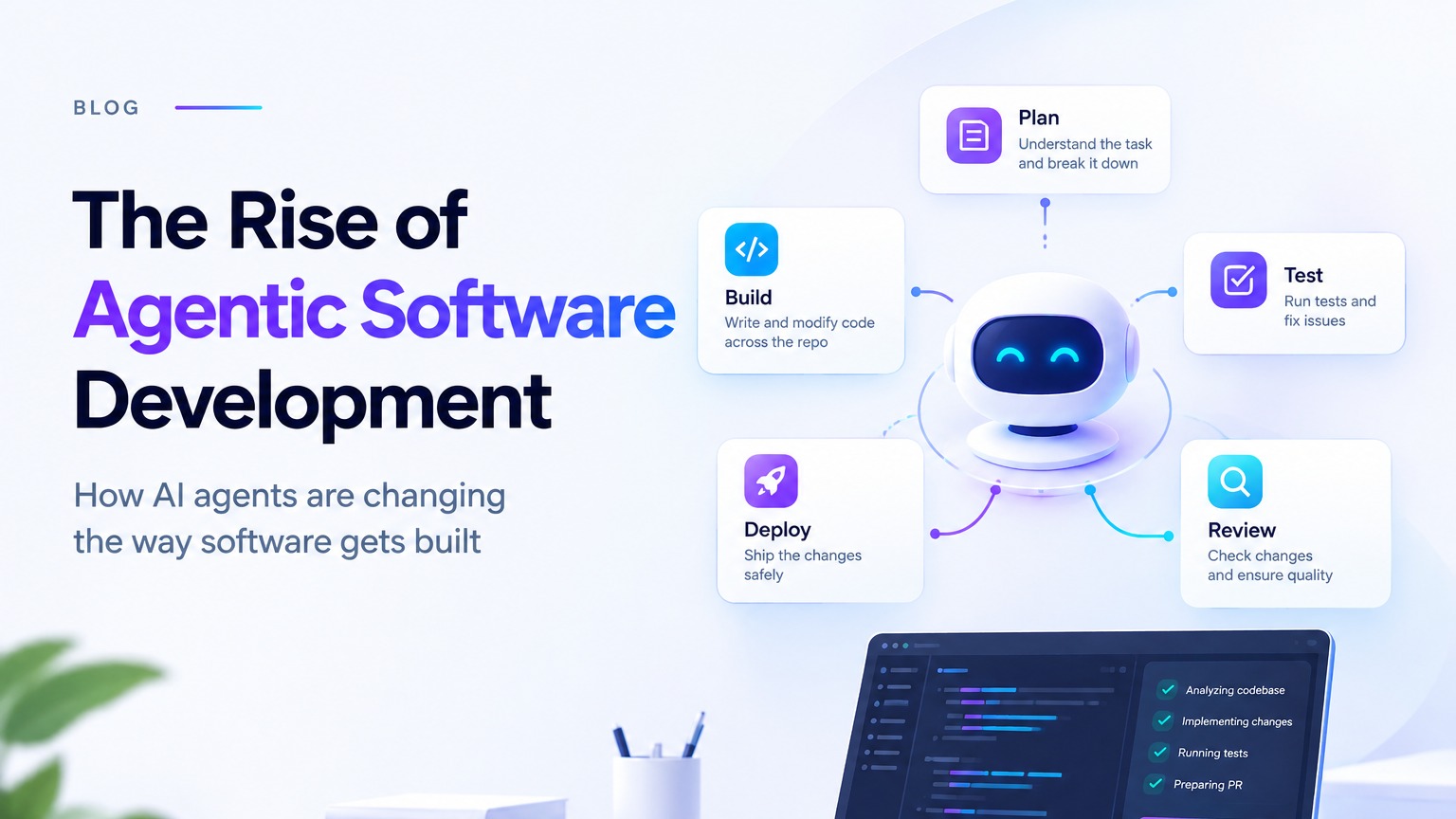
Agentic Software Development Is Changing the Development Process
Software development is entering another major shift.
For years, AI coding tools primarily helped developers write code faster. Autocomplete, code generation, debugging suggestions, and conversational programming became common parts of the developer workflow.
But the next stage is different.
AI coding agents are increasingly being given goals instead of individual instructions.
Instead of asking an AI to write one function, developers can give an agent a larger task:
Understand this issue, inspect the codebase, implement the change, run the tests, identify failures, fix them, and prepare the changes for review.
That changes the role of AI from a coding assistant into an active participant in the software development lifecycle.
Research from JetBrains' 2026 Developer Ecosystem Survey found that 90% of professional developers surveyed were using AI coding agents at work at least weekly, with 68% reporting daily use. (The JetBrains Blog)
The question is no longer whether AI will participate in software development.
The more interesting question is:
What does software development look like when AI agents can handle increasingly large parts of the workflow?
From Code Completion to Coding Agents
The first generation of AI-assisted development focused heavily on code completion.
A developer writes:
const users = await...
The AI suggests the rest.
Useful, but relatively narrow.
Modern coding agents operate at a different level.
They can potentially:
-
Inspect an entire repository
-
Understand relationships between files
-
Create and modify multiple files
-
Run commands
-
Execute tests
-
Investigate errors
-
Search documentation
-
Review implementation choices
-
Iterate on failed attempts
-
Prepare changes for human review
This creates a fundamental distinction:
AI assistance:
Human decides what to do → AI helps implement it.
Agentic development:
Human defines the goal → AI plans and executes multiple steps.
Anthropic's 2026 agentic coding research describes this transition as a shift from writing code toward orchestrating agents that write and work with code. (Anthropic Resources)
The New Software Development Loop
Traditional development often looks like:
Requirement
↓
Developer
↓
Code
↓
Test
↓
Debug
↓
Review
↓
Deploy
AI agents introduce another layer into this process.
A modern workflow can look more like:
Goal
↓
AI Agent
↓
Repository Analysis
↓
Implementation
↓
Testing
↓
Error Analysis
↓
Iteration
↓
Human Review
↓
Deployment
The important change is that the agent can participate across multiple stages instead of generating code at only one point.
This is why the term agentic software development matters.
It describes a workflow, not simply another code generation feature.
1. Developers Become Orchestrators
One of the biggest changes is the shift in developer responsibility.
Developers will still need to understand:
-
Software architecture
-
Data structures
-
APIs
-
Databases
-
Security
-
Infrastructure
-
Testing
-
System design
But increasingly, part of their job becomes deciding what should be built and how the AI should build it.
This makes architectural thinking more important.
An AI agent can generate thousands of lines of code.
It does not automatically mean those lines belong in your architecture.
The developer still needs to determine:
What should exist?
Why should it exist?
What constraints should apply?
What should the agent be allowed to change?
How will we know the result is correct?
The developer moves higher up the abstraction layer.
2. The Repository Becomes the Agent's Context
Traditional coding assistants often work around the file or function currently being edited.
Agents need much broader context.
They may need to understand:
-
Repository structure
-
Existing architecture
-
Database schema
-
API contracts
-
Authentication
-
Business rules
-
Testing conventions
-
Deployment configuration
-
Dependencies
-
Documentation
This makes context engineering increasingly important.
Giving an agent access to a codebase does not automatically mean it understands the codebase correctly.
The surrounding context needs to be structured, accessible, and reliable.
This is one reason concepts such as repository instructions, documentation, tool access, structured context, retrieval, and agent memory are becoming increasingly important in AI development.
3. Testing Becomes More Important, Not Less
There is an obvious temptation with AI coding agents:
If AI writes the code, why do we need extensive testing?
The opposite is closer to reality.
As agents generate more code, validation becomes more important.
A production agentic workflow may involve:
Generate
↓
Test
↓
Observe failure
↓
Diagnose
↓
Modify
↓
Test again
The agent can accelerate the loop.
But the loop still needs reliable tests.
That means teams need:
-
Unit tests
-
Integration tests
-
End-to-end tests
-
Type checking
-
Static analysis
-
Security checks
-
Regression testing
-
CI pipelines
The faster code generation becomes, the more important automated validation becomes.
4. Multi-Agent Development Is Emerging
A single AI agent does not necessarily need to handle everything.
A larger software task can potentially be divided between specialized agents.
For example:
Planning Agent
Breaks the requirement into tasks.
↓
Implementation Agent
Writes the code.
↓
Testing Agent
Creates and runs tests.
↓
Review Agent
Analyzes the implementation.
↓
Security Agent
Checks for vulnerabilities.
↓
Deployment Agent
Prepares the release.
The idea is similar to a software engineering team, except the roles can be coordinated programmatically.
Research from Anthropic identifies multi-agent coordination as one of the trends shaping agentic coding. (Anthropic Resources)
This does not mean every project needs multiple agents.
For many applications, a single well-designed agent with appropriate tools and constraints may be more practical.
The important shift is that software development is becoming increasingly orchestrated.
5. AI Agents Need Tools
An agent that can only generate text has limited ability to affect a software project.
A useful development agent needs tools.
For example:
Repository access
Read and modify source code.
Terminal
Run commands and development tools.
Testing
Execute test suites.
Git
Inspect changes and create commits or branches.
Documentation
Search technical references.
Issue trackers
Read requirements and update task status.
CI/CD
Validate and potentially prepare deployments.
This is where agentic development connects with the broader movement toward tool-enabled AI.
The agent is no longer simply producing an answer.
It is interacting with an environment.
6. Security Becomes a Core Engineering Problem
More capability also creates more risk.
If an AI agent can modify code, execute commands, access databases, and interact with external systems, permissions matter.
A production agent should not automatically have unrestricted access to everything.
Teams need to consider:
-
Authentication
-
Authorization
-
Sandboxing
-
Secret management
-
Tool permissions
-
Network access
-
File permissions
-
Audit logs
-
Human approval
-
Rollback mechanisms
A useful principle is:
Give agents the minimum access required to complete the task.
The more autonomous the system becomes, the more important its boundaries become.
7. The IDE May Become Less Important
The traditional development environment is centered around the developer.
Open an IDE.
Find a file.
Write code.
Run tests.
Inspect errors.
Repeat.
Agentic development can reverse this relationship.
Instead of constantly navigating the repository manually, a developer might increasingly work through higher-level requests:
“Implement this feature.”
“Investigate why these tests are failing.”
“Review this pull request.”
“Find the performance bottleneck.”
“Upgrade this dependency and resolve the resulting issues.”
Gartner has projected that by 2027, more than 65% of engineering teams using agentic coding could treat IDEs as optional, with control, governance, and validation moving toward automated platforms. (Gartner)
That is a prediction, not an established outcome, but it illustrates the direction of the technology.
8. Humans Are Still in the Loop
Agentic does not necessarily mean unsupervised.
In fact, current developer research suggests that many teams are still cautious about giving agents complete autonomy. Stack Overflow's 2026 research found that 63% of technologists surveyed rarely or never allow agents to operate entirely on autopilot. (Stack Overflow Blog)
That makes the emerging model more interesting.
It is not:
Human OR AI
It is:
Human + AI Agent
The human provides:
-
Goals
-
Constraints
-
Architecture
-
Judgment
-
Approval
-
Business context
The agent provides:
-
Execution
-
Iteration
-
Exploration
-
Implementation
-
Testing
-
Automation
The best workflow may therefore be less about replacing developers and more about increasing the amount of meaningful work each developer can supervise.
What This Means for Software Teams
Agentic development changes more than how code is written.
It can change how teams organize work.
Instead of measuring productivity primarily through:
Lines of code
Commits
Tickets completed
Teams may increasingly focus on:
Problems solved
Features delivered
Development cycle time
Quality
Reliability
Business outcomes
The unit of work becomes larger.
Instead of:
“Write this function.”
The request becomes:
“Implement this capability and make sure it works across the application.”
That is a fundamentally different development model.
What Businesses Should Prepare For
Companies do not need to immediately replace their entire development workflow with autonomous agents.
A more practical approach is to start with controlled use cases.
Start with low-risk tasks
Use agents for:
-
Documentation
-
Test generation
-
Refactoring
-
Bug investigation
-
Code review
-
Internal tooling
Build strong engineering foundations
Make sure you have:
-
Good repository structure
-
Automated testing
-
CI/CD
-
Documentation
-
Clear architecture
-
Strong access controls
Introduce agents gradually
Move from:
Assistance
→ Task execution
→ Workflow automation
→ Agent orchestration
Keep humans responsible for critical decisions
Agents can accelerate implementation.
Architecture, security, product decisions, and high-impact changes still require appropriate human oversight.
The Future Is Not Just AI-Generated Code
The most important shift is not that AI can write code.
AI could already do that.
The bigger change is that AI systems are becoming capable of planning, using tools, interacting with environments, and completing longer-running tasks. OpenAI's research on agents describes this transition from individual interactions toward delegated, long-horizon work. (OpenAI)
That means the future of software development may look less like:
Human writes code + AI suggests code
and increasingly like:
Human defines the goal + AI agents execute the workflow + humans provide oversight
The developer does not disappear.
The developer's role evolves.
Final Thoughts
Agentic software development is still evolving.
Not every project needs autonomous coding agents.
Not every task should be delegated.
And more automation does not automatically mean better software.
But the direction is becoming clear.
AI is moving from generating code toward participating in software development.
The teams that benefit most will not simply be the teams using the most AI.
They will be the teams that know how to combine:
AI agents + strong engineering + reliable context + automated validation + human judgment.
That is where agentic software development becomes more than a productivity feature.
It becomes a new way of building software.