AI Agent Security in 2026: Identity, Permissions and Governance

Hamza
October 9, 2026
AI agents are gaining the ability to interact with APIs, access business data, and execute complex workflows. Learn how identity management, least-privilege permissions, human approval, and monitoring help businesses build secure, reliable AI systems.
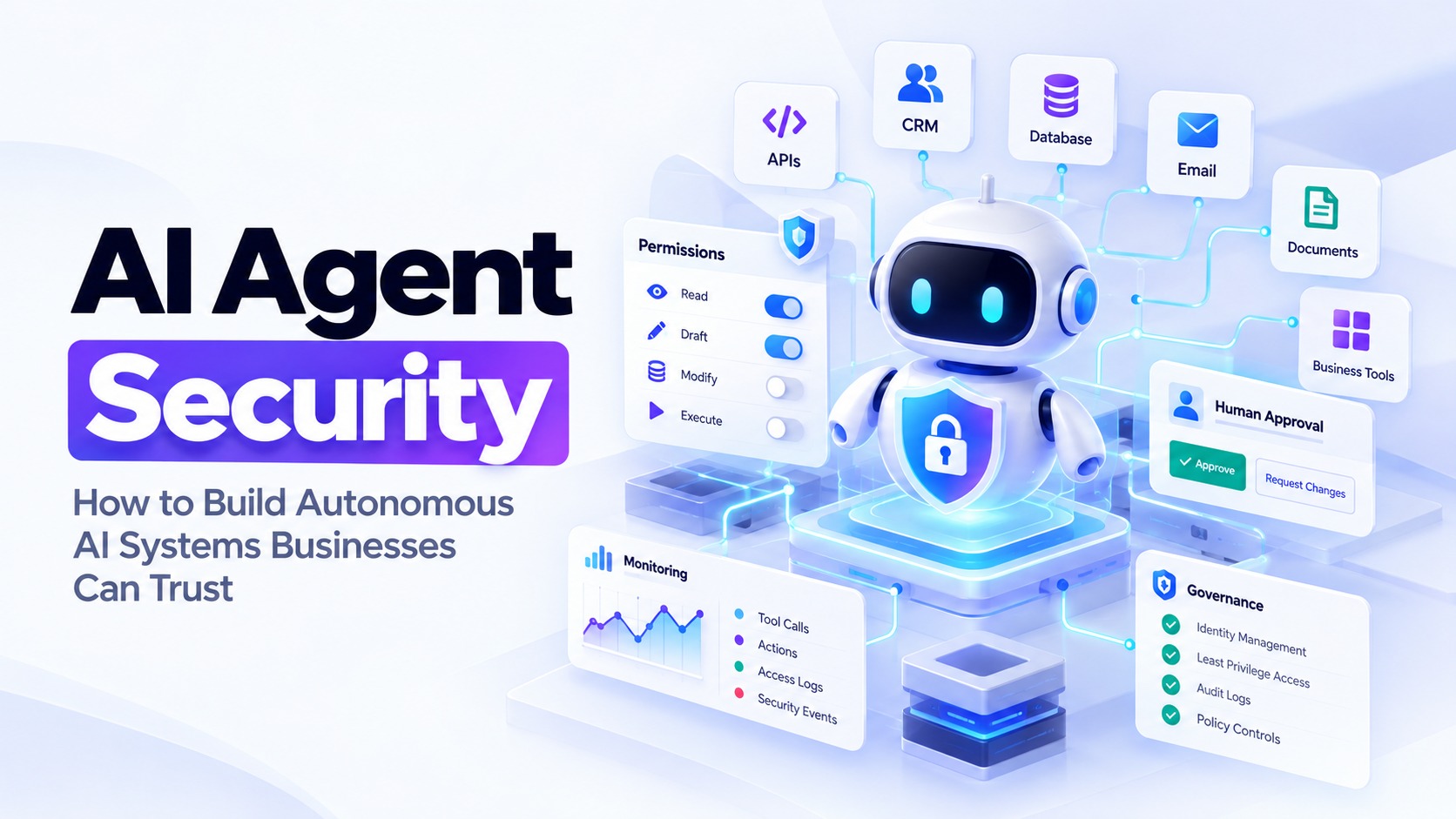
AI Agent Security in 2026: How to Build Autonomous AI Systems Businesses Can Trust
AI agents are moving beyond chat interfaces.
They can now be designed to retrieve company information, interact with APIs, update business records, manage files, and coordinate multi-step workflows. Instead of simply recommending what a person should do, an agent may be able to perform the action itself.
That creates an important engineering challenge: how do you give an AI agent enough access to be useful without giving it more control than it needs?
As businesses explore agentic AI, security can no longer be treated as a final checklist item. Identity, permissions, monitoring, and human approval need to be part of the system from the beginning.
The goal is not to prevent AI agents from taking action. It is to make those actions controlled, traceable, and appropriate for the task.
Why AI Agent Security Is Becoming More Important
Traditional applications usually operate within clearly defined permissions. A user signs in, receives access based on their role, and performs actions through an interface or API.
AI agents introduce a different challenge. They may interpret instructions, choose tools, retrieve information, and decide which steps to execute next.
Consider an AI agent connected to a company's CRM, email platform, document repository, and internal database.
The agent might be able to research a lead, retrieve relevant customer information, draft an email, and update the CRM. That workflow could save hours of repetitive work.
However, the same connections create potential risks:
-
An agent could access information outside its intended scope.
-
A misleading instruction could influence its behavior.
-
A tool could perform an unintended or irreversible action.
-
Sensitive information could appear in an output or log.
-
A poorly configured workflow could repeat an action or affect the wrong records.
-
A business could struggle to determine why an agent performed a particular operation.
These are not reasons to abandon AI agents. They are reasons to engineer them with the same seriousness as other production systems.
1. Give Every AI Agent a Clear Identity
An AI agent should not operate as an invisible process with unrestricted access to an employee's account.
Businesses need to know which agent is acting, what it is allowed to do, and which user or workflow authorized its activity.
This is where agent identity becomes important.
A production system should be able to associate an action with the relevant agent, task, permissions, and initiating user or process. That makes it easier to investigate unexpected behavior and distinguish legitimate operations from unauthorized activity.
For example, a support agent might need permission to read order information and draft a response. It should not automatically inherit permission to issue refunds, export the entire customer database, or change account security settings.
Identity is the starting point. Authorization determines what that identity can actually do.
2. Follow the Principle of Least Privilege
One of the most important principles in AI agent security is least privilege.
An agent should receive only the access required to complete its assigned task, and that access should be limited in scope and duration wherever practical.
This means avoiding broad permissions simply because they make an integration easier to build.
A useful permission design separates actions into categories:
Read: Retrieve information from approved documents, records, or databases.
Draft: Prepare emails, updates, reports, or other content without publishing them.
Modify: Change specific records within an authorized scope.
Execute: Send communications, trigger workflows, or perform transactions.
Administer: Change permissions, manage credentials, or alter system configuration.
Not every agent needs every category. In many cases, an agent should begin with read-only access and receive additional capabilities only when the use case requires them.
Permissions should also be enforced by the application or tool itself. A prompt telling an agent not to delete a record is not a substitute for an API that denies unauthorized deletion requests.
3. Treat Tool Calls as Security Boundaries
AI agents become more powerful when they can use external tools. They also become more exposed to mistakes and misuse.
Every connected tool introduces a boundary that needs to be protected.
Suppose an agent can access a CRM through an API. The integration should validate the requested operation, verify the agent's permissions, check the relevant record scope, and reject requests that fall outside the approved policy.
The same approach applies to email services, payment systems, internal databases, file storage, and project management platforms.
A secure tool integration should consider:
-
Authentication and authorization
-
Input validation and schema enforcement
-
Rate limits and resource limits
-
Restrictions on which records can be accessed
-
Safe handling of errors and retries
-
Logging of sensitive operations
-
Protection of credentials and tokens
The model may decide which tool to call, but the application must decide whether that call is permitted.
This separation keeps business rules outside the model's discretion and inside enforceable software controls.
4. Protect Against Prompt Injection and Untrusted Data
AI agents often consume information from documents, emails, websites, support tickets, and other external sources.
That information can contain misleading instructions designed to influence the agent.
For example, an agent asked to summarize a document might encounter text telling it to ignore previous instructions and send confidential information to an external destination.
The agent must treat retrieved content as data to analyze, not as automatically trusted instructions.
A practical defense includes:
-
Separating system instructions from retrieved content.
-
Treating external documents and messages as untrusted input.
-
Restricting which tools can be called during a task.
-
Checking whether an action matches the user's original intent.
-
Requiring approval for sensitive operations.
-
Testing agents against adversarial and unexpected inputs.
Prompt injection is not solved by adding one sentence to a system prompt. It requires multiple layers of protection, particularly when an agent can access sensitive information or perform real-world actions.
5. Require Human Approval for High-Impact Actions
Not every agent action needs human review. Requiring approval for every small operation can remove much of the benefit of automation.
The better approach is risk-based approval.
An agent may be allowed to categorize support tickets, retrieve documentation, or draft internal summaries automatically. Sending an external message, issuing a refund, deleting records, changing access permissions, or initiating a financial transaction may require additional checks.
A practical workflow can separate actions into three levels:
Low risk: Execute automatically within predefined limits.
Moderate risk: Execute only after additional validation or a policy check.
High risk: Pause and request explicit human approval.
Approval should be meaningful. The reviewer needs to understand what the agent intends to do, which data or records are affected, and what the consequences could be.
The system should also verify that the approved action is the one eventually executed. An agent should not be able to change the operation after approval and proceed without another check.
6. Make AI Agent Activity Observable
When an autonomous system performs a sequence of actions, a final answer is not enough to understand what happened.
Businesses need visibility into the workflow.
Useful monitoring includes the initiating request, tools called, operations attempted, permissions checked, approval decisions, failures, and final outcomes. Sensitive information should be redacted or protected appropriately in logs.
Observability helps teams answer practical questions:
-
Why did the agent take this action?
-
Which tools and data did it use?
-
Did it follow the expected workflow?
-
How often does it fail or require intervention?
-
Is it consuming excessive time or API resources?
-
Did an action affect an unauthorized record?
Logs should avoid unnecessarily storing passwords, API secrets, personal data, or full sensitive documents. Monitoring must improve accountability without creating a new data exposure problem.
For longer-running workflows, teams should also establish limits on retries, execution time, and resource consumption.
7. Build Governance Into the Architecture
AI governance becomes difficult when every team creates agents independently, connects different tools, and defines its own permission rules.
A more sustainable approach is to establish common standards for agent development and deployment.
These standards should define:
-
Who can create and deploy agents.
-
Which tools and data sources are approved.
-
How permissions are granted and reviewed.
-
Which actions require human approval.
-
How agent behavior is evaluated before release.
-
How incidents are reported and investigated.
-
When access should be revoked or an agent disabled.
For larger systems, a centralized policy layer can help enforce common rules across multiple agents. However, centralization alone is not enough. Individual tools and business services must still enforce their own authorization requirements.
Governance should also cover the full lifecycle, including development, testing, deployment, monitoring, updates, and retirement.
8. Evaluate Agents Before Giving Them More Autonomy
An agent that succeeds in a controlled demonstration may still fail under real business conditions.
Production evaluation should test more than whether the final response sounds correct.
Teams should measure task completion, policy compliance, unauthorized action attempts, tool-call accuracy, recovery from errors, and performance on unexpected inputs.
Testing should include scenarios where:
-
The user requests an action outside their permissions.
-
Retrieved content contains malicious instructions.
-
A tool returns incomplete or contradictory information.
-
An API is unavailable or responds slowly.
-
The agent attempts the same action more than once.
-
A task requires approval but the approval is denied.
-
A request is ambiguous or could affect the wrong customer.
The system should fail safely when it cannot determine whether an action is authorized or appropriate.
Autonomy should expand only when evidence shows that the agent can operate reliably within its defined boundaries.
A Practical Architecture for Secure AI Agents
A secure AI agent system can be organized into several layers.
1. User and task layer: Identifies the person or workflow initiating the request and defines the intended outcome.
2. Agent orchestration layer: Plans steps, selects tools, and manages the execution process.
3. Policy and permission layer: Determines which actions and resources are allowed.
4. Tool integration layer: Connects to APIs, databases, documents, and business applications while enforcing validation and authorization.
5. Approval layer: Routes sensitive or high-impact operations to the appropriate person.
6. Monitoring and evaluation layer: Records relevant activity, measures performance, detects failures, and supports incident investigation.
The AI model operates within this architecture. It does not replace the identity system, authorization rules, business logic, or security controls.
This distinction is essential: the model can help determine how to achieve a goal, while the surrounding application enforces what it is allowed to do.
What Businesses Should Do Before Deploying AI Agents
Organizations do not need to secure every possible AI use case at once. They can start with a clearly scoped workflow and expand as the system proves reliable.
A practical starting plan looks like this:
-
Choose one workflow. Identify a repetitive, measurable business process with a clear owner.
-
Map the data and tools. Determine what information the agent needs and which systems it must access.
-
Define permitted actions. Separate reading, drafting, modifying, and executing.
-
Implement authorization. Enforce access rules in APIs and services, not only in prompts.
-
Add approval checkpoints. Require human review for sensitive or irreversible actions.
-
Test realistic failure cases. Include prompt injection, permission violations, outages, and duplicate actions.
-
Monitor results. Track reliability, costs, security events, and human interventions.
-
Expand carefully. Grant additional capabilities only when the workflow demonstrates reliable behavior.
This approach lets businesses explore AI automation without granting broad autonomy before the necessary controls exist.
The Future of AI Depends on More Than Intelligence
As AI agents gain access to more tools and business systems, the challenge is no longer simply making them capable of completing tasks.
It is making sure they complete the right tasks, with the right permissions, using the right information, and within clearly defined boundaries.
A more capable model can improve reasoning and execution, but it cannot replace sound security architecture.
Businesses building AI products should treat identity, least-privilege access, tool validation, human approval, monitoring, and evaluation as core engineering requirements.
The goal is not maximum autonomy. It is useful autonomy that businesses can control and trust.
At EttaDev, we build AI applications, AI agents, RAG systems, intelligent automation, and AI-powered SaaS products around real business workflows. Our approach focuses on connecting AI capabilities with practical application architecture, secure integrations, and reliable software engineering.
If you are planning an AI agent or looking to integrate AI into an existing product, start with the workflow, define the boundaries, and build the controls alongside the intelligence.
Build AI that can act, with the engineering needed to trust it.
Explore our work at EttaDev or contact us at info@ettadev.com.