AI Coding Agents in 2026: Faster Development Without Technical Debt

Salman
October 16, 2026
AI coding agents can accelerate implementation, but faster code generation does not guarantee better software. Explore practical ways to maintain quality, control costs, and ship dependable products.
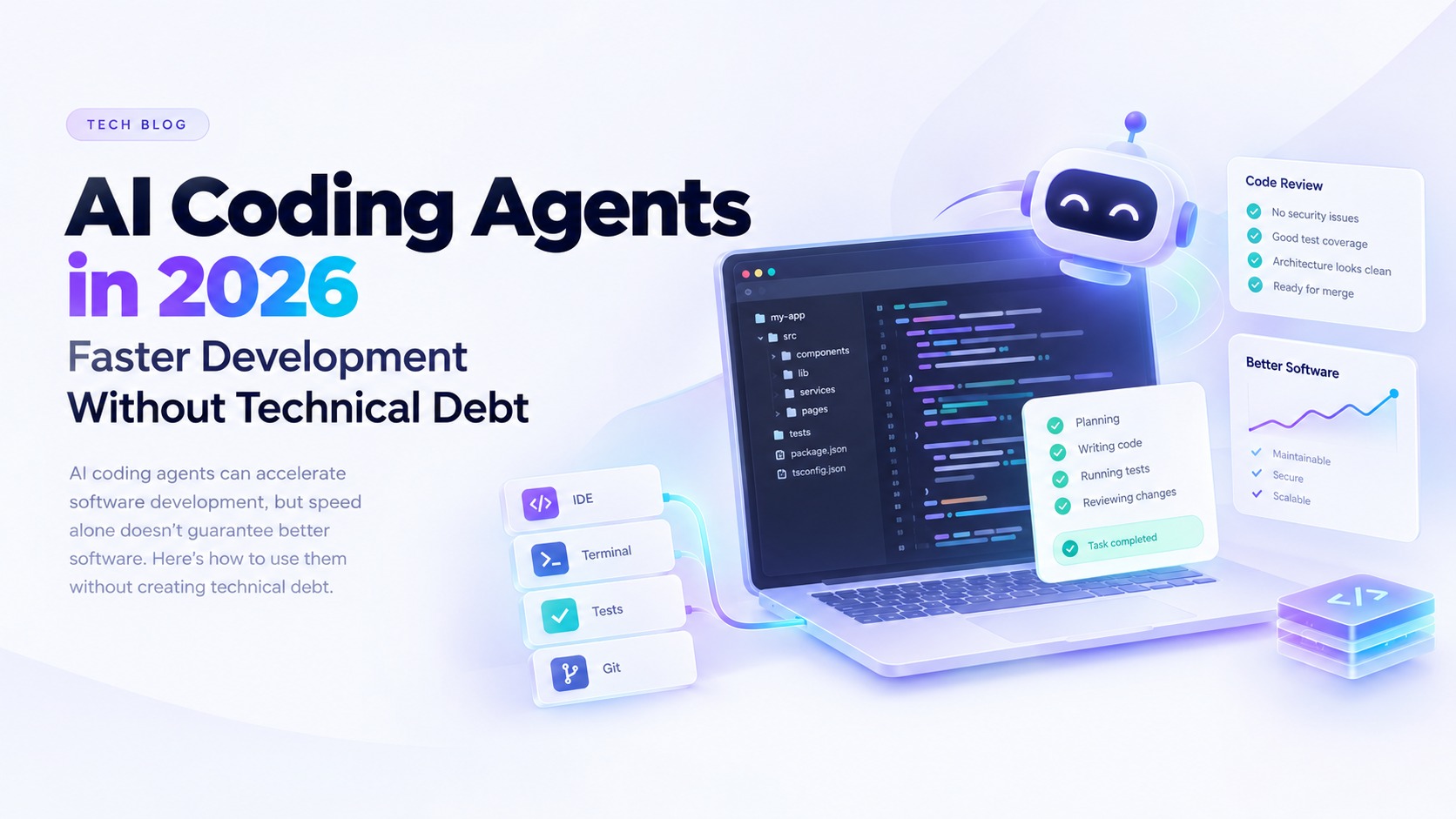
AI Coding Agents in 2026: Faster Development Without Technical Debt
Artificial intelligence is changing how software gets built. Developers can now delegate implementation tasks to AI coding agents that inspect repositories, write code, run commands, investigate errors, and iterate on solutions with less manual intervention.
For businesses, this creates an opportunity to accelerate product development, reduce repetitive engineering work, and bring new features to market faster.
But there is an important distinction: generating code faster is not the same as delivering better software faster.
If AI-generated code introduces bugs, increases review workloads, weakens architecture, or becomes difficult to maintain, the time saved during implementation can be lost later.
The challenge in 2026 is no longer simply adopting AI coding tools. It is building an engineering process that turns their speed into reliable business outcomes.
In this guide, we explore how AI coding agents work, the risks businesses should understand, and the engineering practices that help teams benefit from AI without accumulating unnecessary technical debt.
What Are AI Coding Agents?
AI coding agents are systems that can perform multi-step software development tasks rather than simply suggest code snippets.
A traditional AI coding assistant typically responds to a question, completes a function, or recommends a change. An AI coding agent can take a broader task, break it into smaller steps, inspect the existing codebase, make changes, run tests, examine errors, and attempt corrections.
Depending on the tool and its permissions, an agent may be able to:
-
Understand an existing code repository.
-
Implement features across multiple files.
-
Run terminal commands and development tools.
-
Generate and execute tests.
-
Investigate build failures and runtime errors.
-
Review code changes and suggest improvements.
-
Prepare changes for human review.
For example, a developer might request a new authentication flow. An agent could inspect the existing authentication architecture, identify the relevant components, implement changes, run tests, and report what it modified.
The developer remains responsible for determining whether the implementation is correct, secure, and suitable for the application.
Google Cloud's guide to agentic coding, updated in September 2026, explains this shift from asking AI for individual coding suggestions to delegating broader implementation tasks.
Why AI Coding Agents Are Trending in 2026
AI-assisted development has moved beyond experimental use. Coding agents are increasingly becoming part of everyday software engineering workflows.
JetBrains' 2026 Developer Ecosystem Survey, which covered more than 15,000 professional developers, reported that 90% of respondents used AI coding agents at work at least weekly during May to July 2026, while 68% reported daily use. These findings describe the survey's respondents, not every developer worldwide. Read the JetBrains research.
Several developments explain this adoption.
1. Agents can handle multi-step tasks
Instead of manually guiding AI through every small change, developers can delegate a task and let an agent work through several implementation steps.
2. Existing tools are becoming more capable
Modern coding agents can interact with repositories, terminals, testing tools, and other development systems, allowing them to work within a broader engineering workflow.
3. Teams want shorter development cycles
Businesses are under pressure to release features, validate ideas, and respond to customer feedback. AI agents offer a way to reduce repetitive implementation work.
4. AI is changing engineering workflows
The impact extends beyond writing code. Planning, testing, documentation, code review, and maintenance also need to adapt as code generation becomes faster.
The opportunity is significant, but adoption alone does not guarantee better engineering outcomes.
The Hidden Problem: More Code, More Review
One of the biggest challenges with AI coding agents is that code can be generated faster than teams can validate it.
A feature may compile successfully and pass basic tests while still containing inefficient queries, incomplete error handling, architectural inconsistencies, or security weaknesses.
The Software Improvement Group's State of Software 2026 report highlights this concern. Its analysis reports that AI-generated code had roughly twice the security risk violations of human-written code in its assessment. This is a finding from the report's analysis, not a universal rate for every AI tool or codebase.
The practical lesson is not to avoid AI-generated code. It is to avoid treating generated code as automatically production-ready.
Teams need to evaluate code for:
-
Correctness and edge cases.
-
Security and access control.
-
Performance and resource usage.
-
Test coverage and failure handling.
-
Maintainability and architectural consistency.
-
Compatibility with existing application behavior.
AI should help teams move faster through these checks, not become a reason to skip them.
Five Risks Businesses Should Understand
1. Technical debt accumulates faster
Technical debt develops when implementation shortcuts create additional work for future developers.
AI agents can introduce duplicated logic, unnecessary abstractions, inconsistent patterns, and quick fixes that solve the immediate problem without addressing the underlying cause.
Individually, these changes may appear harmless. Across a growing application, they can make future features slower and more expensive to implement.
What helps: Establish coding standards, enforce architectural boundaries, review significant changes, and refactor problematic areas before they spread.
2. Code review becomes a bottleneck
When developers and coding agents generate more pull requests, reviewers may struggle to keep up.
A Harvard-backed study discussed by TechRadar in October 2026 reported increased code production alongside longer review and merge times. The findings suggest that accelerating implementation without improving review workflows can limit the overall benefit.
What helps: Keep changes small, automate routine checks, use focused review tools, and reserve human attention for decisions that require engineering judgment.
AI code review can assist with identifying potential problems, but its findings also need validation. Teams should measure how often reviewers catch genuine issues and how much irrelevant feedback automated tools produce.
3. Security gaps enter production
An AI coding agent may generate code that appears functional but mishandles authentication, exposes sensitive information, trusts unvalidated input, or grants excessive permissions.
The risk increases when agents can execute commands, access secrets, or interact with production systems.
What helps: Use least-privilege access, protect credentials, scan dependencies, validate inputs, run security checks, and require human approval for sensitive changes or deployments.
4. AI costs become unpredictable
AI coding agents consume resources while planning tasks, reading files, generating code, running tools, and attempting corrections.
Complex tasks can require substantially more model usage than simple coding questions. Repeated attempts and poorly scoped work can increase costs without delivering equivalent value.
What helps: Track model usage and cost per completed task, select appropriate models, limit unnecessary context, and monitor repeated tool calls.
The objective is not simply to minimize AI spending. It is to improve the amount of useful, maintainable software delivered for that spending.
5. Architecture becomes inconsistent
An agent may solve the task it receives without fully understanding the long-term needs of the entire product.
Different changes can introduce competing patterns, overlapping utilities, duplicated business logic, or unnecessary dependencies.
What helps: Give agents clear repository guidance, define architectural boundaries, reuse established patterns, and review cross-cutting changes at the system level.
A Practical Framework for Using AI Coding Agents
Businesses do not need to choose between fully manual development and unrestricted AI autonomy. A controlled workflow can combine AI speed with established engineering discipline.
Step 1: Define the task clearly
Break large requirements into smaller, testable objectives. Specify expected behavior, constraints, relevant files or modules, and acceptance criteria.
Vague instructions make it harder to determine whether an agent has solved the actual problem.
Step 2: Give the agent the right context
Provide relevant documentation, repository conventions, API contracts, database relationships, and testing requirements.
More context is not always better. Unrelated information can increase cost and distract the agent from the task.
Step 3: Work in small changes
Prefer focused implementations over large, difficult-to-review changes. Separate unrelated features and make the resulting code easier to understand and test.
Step 4: Validate automatically
Use appropriate checks for the project, including:
-
Type checking and linting.
-
Unit and integration tests.
-
API contract validation.
-
Dependency and security scanning.
-
Build and deployment checks.
These checks catch many problems early, although they cannot prove that software is free of defects.
Step 5: Review the result
A human engineer should examine important changes for correctness, architecture, security, performance, and maintainability.
AI-generated review comments can support this process, but they should not replace engineering accountability.
Step 6: Monitor software after release
Measure real application performance, errors, reliability, resource usage, and user feedback.
Production monitoring reveals issues that may not appear in a development environment or test suite.
Step 7: Measure outcomes, not code volume
The number of generated lines or completed pull requests is not enough to evaluate success.
More useful measurements include:
-
Time from requirement to successful release.
-
Defect rates after deployment.
-
Review and rework time.
-
Change failure rates.
-
Cost per completed feature.
-
Application performance and reliability.
-
Time required to maintain existing functionality.
The goal is to improve delivery without creating a larger maintenance burden.
Where EttaDev Fits In
AI coding agents can accelerate implementation, but businesses still need software architecture, integration, testing, deployment, and long-term maintenance.
EttaDev helps businesses turn software requirements into practical, maintainable applications. Our work spans custom web applications, SaaS development, AI integrations, intelligent automation, and backend engineering.
Here are some of the problems we help address.
Custom software and SaaS development
When a business needs a new product, internal platform, or customer-facing application, EttaDev can help with architecture, frontend and backend implementation, database design, API development, and deployment.
The focus is on building software around actual business workflows rather than generating code without a product strategy.
AI integration into existing applications
Businesses often need AI capabilities inside an existing product rather than a standalone chatbot.
EttaDev can help integrate LLMs, document retrieval, AI-powered workflows, and external services into applications with appropriate validation, error handling, and access controls.
Application performance and backend optimization
Slow APIs, inefficient database queries, and unnecessary processing can affect the user experience and operating costs.
Our engineering work can include profiling, query optimization, API improvements, caching, and frontend performance improvements based on the application's actual bottlenecks.
Code quality and maintainability
When a codebase becomes difficult to extend, teams may need architectural improvements, refactoring, testing, or better separation of responsibilities.
EttaDev can help assess these problems and prioritize improvements that make the software easier to maintain and extend.
Turning an MVP into a dependable product
A prototype can demonstrate an idea, but a real product also needs authentication, error handling, data integrity, monitoring, deployment workflows, and support for changing requirements.
EttaDev helps businesses move from early implementations toward software that is more suitable for real users and ongoing development.
AI coding agents can be part of that process. The value comes from combining them with sound engineering practices and clear business objectives.
Frequently Asked Questions
1. What are AI coding agents?
AI coding agents are tools that can plan and perform multi-step software development tasks, such as inspecting repositories, editing files, running tests, and investigating errors. Their capabilities depend on the tool, its permissions, and the environment in which it operates.
2. How are AI coding agents different from AI coding assistants?
An AI coding assistant commonly suggests code or responds to specific developer requests. A coding agent can take a broader objective and execute several steps using available tools. The distinction is not absolute because modern products may support both interaction styles.
3. Can AI coding agents replace software developers?
AI coding agents can automate parts of implementation, testing, and maintenance, but they do not eliminate the need for engineering judgment. Requirements analysis, system architecture, security decisions, complex debugging, and accountability still require appropriate human oversight.
4. Does AI-generated code create technical debt?
It can. Poorly scoped tasks, duplicated logic, weak tests, and inconsistent architecture can make code harder to maintain. However, AI-generated code does not automatically create technical debt. Clear standards, review, testing, and ongoing refactoring help control the risk.
5. Is AI-generated code safe for production?
It can be used in production when it passes the same appropriate quality and security checks as other code. Teams should validate behavior, test edge cases, review sensitive changes, scan dependencies, protect secrets, and monitor the application after deployment.
6. How can businesses measure the ROI of AI coding agents?
Measure the cost and time required to deliver working software, then compare those results with defect rates, rework, review time, maintenance effort, and release quality. Increased code generation alone does not demonstrate a positive return on investment.
7. Which AI coding agent should a business choose?
The best choice depends on the team's technology stack, repository size, privacy requirements, integrations, pricing, access controls, and evaluation results. Teams should test candidate tools against representative tasks rather than choosing solely on popularity or demonstrations.
8. Can AI coding agents work with an existing codebase?
Yes. Many agents can inspect and modify existing repositories, but their effectiveness depends on code quality, documentation, test coverage, and access to relevant context. Start with a limited task, review the changes, and expand usage after validating the results.
9. How can a company use AI coding agents without sacrificing software quality?
Define clear tasks, maintain repository standards, work in small changes, automate tests and security checks, review important modifications, and monitor production behavior. AI should accelerate the engineering process while quality requirements remain unchanged.
10. How can EttaDev help businesses build software with AI?
EttaDev provides custom software and SaaS development, AI integrations, intelligent automation, backend engineering, and application optimization. We help businesses design and build applications around their requirements, with attention to architecture, reliability, maintainability, and practical business outcomes.
Conclusion
AI coding agents are changing the economics and workflow of software development. They can reduce repetitive work, accelerate implementation, and help teams explore solutions more quickly.
But the strongest results come when faster code generation is supported by reliable engineering practices.
Businesses need clear requirements, sound architecture, automated testing, effective review, security controls, and measurable outcomes. Without these foundations, faster implementation can simply move the bottleneck from writing code to reviewing, correcting, and maintaining it.
The real advantage is not generating more code. It is delivering better software with less unnecessary effort.
At EttaDev, we help businesses build custom software, SaaS platforms, AI integrations, and intelligent workflows with practical engineering at the core.
Have a product idea or an existing application you want to improve?
Let's build software that moves your business forward.
Website: https://www.ettadev.com
Email: info@ettadev.com