AI Document Chat & Deep Research Platform | EttaDev Case Study

Hamza
August 25, 2026
Discover how EttaDev built an AI Document Chat and Deep Research Platform combining multi source RAG, LLM driven intent detection, and LangChain research agents to automate research and deliver grounded AI powered insights.
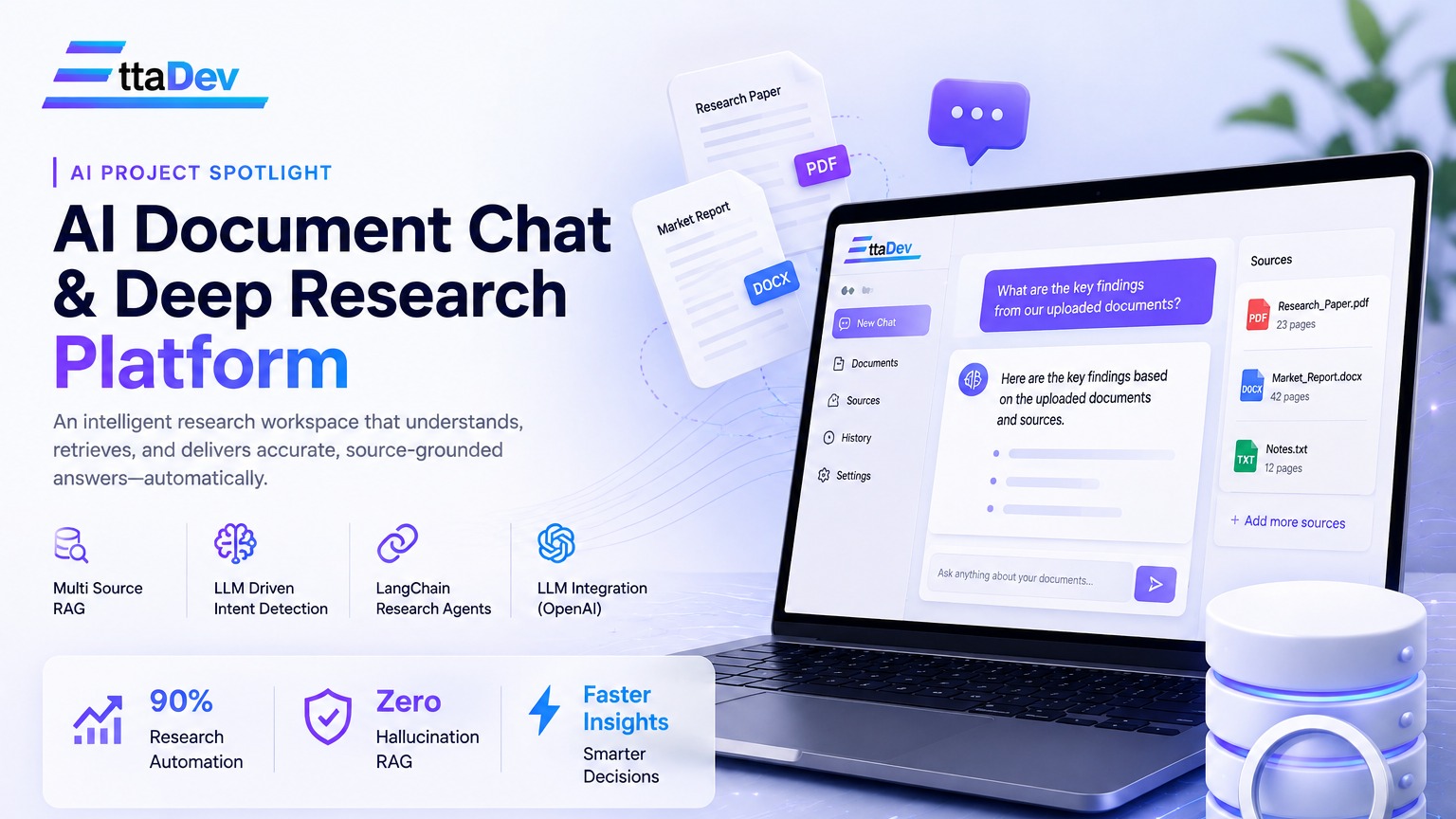
AI Document Chat and Deep Research Platform: Building an Intelligent Research Workspace
AI Document Chat | RAG | Deep Research | LangChain | Next.js | FastAPI
Research can become difficult when the information you need is spread across large documents, multiple sources, and disconnected knowledge bases.
Reading through hundreds of pages manually takes time. Traditional search often depends on exact keywords and can struggle to understand the context behind a question. General purpose AI assistants can answer questions quickly, but without access to reliable source material, their responses may not always be grounded in the information a business actually needs.
This is where intelligent document processing and retrieval augmented generation can make a significant difference.
At EttaDev, we built an AI Document Chat and Deep Research Platform designed to make complex research faster, more accessible, and more automated. The platform combines multi source RAG, LLM driven intent detection, and LangChain research agents inside a production focused workspace. The result is an AI research experience designed to retrieve relevant information, understand user intent, and generate useful answers from connected sources.
The platform achieved 90% research automation while focusing on grounded retrieval and reliable information access. (ettadev.com)
The Challenge: Researching Information at Scale
For many teams, important knowledge already exists.
It may be stored inside reports, research documents, internal documentation, knowledge bases, or other information sources. The problem is not necessarily a lack of information. The problem is finding the right information quickly.
Traditional research workflows often look something like this:
-
Search through multiple documents
-
Open relevant files
-
Read through large sections of content
-
Compare information between sources
-
Extract important findings
-
Summarize the information
-
Repeat the process whenever a new question appears
This workflow becomes increasingly difficult as the volume of information grows.
A simple keyword search may find a matching phrase, but it does not necessarily understand what the user is actually asking. On the other hand, a general AI chatbot may produce a fluent answer without being sufficiently grounded in the organization's source material.
The project needed a different approach.
The goal was to create an AI document research platform where users could interact with information naturally while the underlying system focused on retrieving relevant context and producing grounded responses.
The Solution: AI Document Chat and Deep Research
EttaDev engineered a research workspace combining multi source retrieval augmented generation, LLM driven intent detection, and LangChain research agents. (ettadev.com)
Instead of forcing users to manually search through documents, the platform allows them to interact with their information through an AI powered interface.
A user can ask a question in natural language.
The system then needs to understand the intent behind that question, identify relevant information, retrieve useful context, and use that context to produce an answer.
This creates a workflow where AI is not simply generating text.
It is helping users find, understand, and work with information.
That distinction is important when building AI applications for research and knowledge intensive workflows.
Multi Source RAG for Grounded Information Retrieval
One of the core technologies behind the platform is Retrieval Augmented Generation, commonly known as RAG.
Traditional LLM applications rely heavily on the knowledge available to the model. RAG introduces an additional retrieval layer that allows an application to retrieve relevant information from external sources before generating a response.
In a document research platform, this creates a more useful workflow:
User Question → Retrieval → Relevant Context → LLM → Answer
The platform extends this concept through multi source RAG, allowing information to be retrieved across multiple connected sources rather than relying on a single knowledge repository. (ettadev.com)
This is particularly valuable for research workflows because useful information is rarely located in one place.
A question may require context from several documents or sources. Instead of asking users to manually locate those pieces of information, the retrieval layer helps bring relevant context into the research process.
The objective is simple:
Give the model better context before asking it to generate an answer.
This approach also supports the platform's focus on zero hallucination RAG, a key result highlighted in the EttaDev portfolio. (ettadev.com)
Rather than treating an LLM as an unrestricted answer generator, the system is designed around retrieving relevant information and grounding the research experience in available sources.
Understanding User Intent with LLMs
Retrieval alone is not enough.
A user can ask the same question in many different ways. They may ask for a summary, request specific information, compare two concepts, or ask a more complex research question.
This is where LLM driven intent detection becomes important.
The platform uses language models to understand what the user is actually trying to accomplish.
Instead of treating every query as a simple search request, the system can interpret the user's intent before determining how the research workflow should proceed.
For an AI research platform, this creates a more natural interaction model.
Users do not need to learn complicated search syntax.
They can communicate with the platform in natural language.
The system is responsible for interpreting that request and connecting it with the appropriate research workflow.
LangChain Research Agents
Another important part of the platform is its use of LangChain research agents. (ettadev.com)
AI agents extend traditional question and answer systems by allowing an LLM to participate in a more structured, multi step workflow.
Instead of simply receiving a question and immediately generating a response, an agent based research workflow can break a complex task into smaller steps.
For example, a research request may involve:
Understand → Search → Retrieve → Analyze → Combine → Respond
This is particularly useful for deep research scenarios where a single retrieval operation may not provide enough context.
LangChain provides the orchestration layer that helps connect language models with the tools and workflows required for these types of applications.
For EttaDev, this made it possible to move beyond a basic document chatbot and build a more capable AI deep research platform.
From Document Chat to Deep Research
There is an important difference between document chat and deep research.
Document chat is primarily about asking questions against a specific body of information.
Deep research goes further.
A deep research workflow needs to understand the question, identify relevant information, evaluate context, and combine findings into a useful response.
This distinction influenced the architecture of the platform.
The objective was not simply:
"Ask a question about a document."
The broader objective was:
"Help users investigate complex information through an intelligent research workflow."
That shift makes the platform more useful for research intensive environments where users need more than simple document search.
A Modern Full Stack Architecture
The platform is built using a modern full stack architecture with Next.js, FastAPI, and LangChain among its core technologies. (ettadev.com)
Next.js
Next.js provides the frontend foundation for the research workspace.
For an AI application, the interface needs to make complex workflows feel simple. Users should be able to interact with documents, submit questions, review responses, and navigate research results without needing to understand the underlying AI infrastructure.
FastAPI
FastAPI provides the backend layer for the application.
It is well suited to AI and machine learning applications where the backend needs to communicate with language models, retrieval systems, and other services.
For this platform, the backend acts as the bridge between the user experience and the AI research pipeline.
LangChain
LangChain provides the orchestration layer for the platform's research agents and LLM driven workflows.
Together, these technologies create a full stack foundation for building an AI powered research application.
Automating the Research Workflow
One of the most significant outcomes of the project is 90% research automation. (ettadev.com)
Research automation is not simply about generating an answer faster.
The bigger opportunity is reducing the amount of repetitive work required to reach that answer.
Instead of manually moving between documents, searching for keywords, extracting information, and creating summaries, users can interact with an intelligent research workspace.
This can help transform the workflow from:
Manual Search → Manual Reading → Manual Extraction → Manual Analysis
into:
Question → AI Retrieval → AI Analysis → Actionable Insight
That does not eliminate the need for human expertise.
Instead, it gives researchers a faster way to access and work with the information they already have.
Why Grounded AI Matters
One of the biggest challenges when building AI applications is reliability.
A response can sound convincing while still being incorrect.
This is especially problematic when AI is being used for research.
A research platform therefore needs to place greater emphasis on the relationship between the generated answer and the information used to produce it.
The platform's zero hallucination RAG positioning reflects this focus. (ettadev.com)
The underlying principle is straightforward:
Better retrieval leads to better context, and better context gives the model a stronger foundation for generating useful answers.
This is one of the reasons RAG has become an important architecture for enterprise AI, document intelligence, knowledge management, and AI search applications.
Designing AI Around Real Workflows
A common mistake when building AI products is starting with the technology rather than the problem.
It is easy to say:
"We need an LLM."
The harder question is:
What should the AI actually help the user accomplish?
For this project, the focus was research.
That meant the technology had to support:
-
Natural language interaction
-
Document and information retrieval
-
Context aware responses
-
Intent understanding
-
Multi source research
-
Agent based workflows
-
Automated research processes
This is where AI engineering becomes different from simply integrating an API.
The goal is not to add AI because AI is popular.
The goal is to design an intelligent workflow where AI solves a specific operational problem.
The Impact
The AI Document Chat and Deep Research Platform demonstrates what happens when modern AI technologies are combined around a practical business workflow.
The project delivered:
90% Research Automation
A significant portion of the research workflow was automated, reducing repetitive manual work. (ettadev.com)
Zero Hallucination RAG
The platform was designed around grounded retrieval to keep AI responses connected to relevant source information. (ettadev.com)
Multi Source RAG
Information retrieval was designed to work across multiple sources rather than relying on a single knowledge base. (ettadev.com)
LLM Driven Intent Detection
The system uses LLM based intent understanding to interpret research requests more intelligently. (ettadev.com)
LangChain Research Agents
Agent based workflows enable the platform to support more advanced research tasks rather than simple question and answer interactions. (ettadev.com)
What This Project Demonstrates
This project represents an important direction in modern software development.
AI applications are moving beyond simple chat interfaces.
The next generation of AI products will combine:
LLMs + RAG + Agents + Data + Software Engineering
to create systems that can actually participate in business workflows.
The AI Document Chat and Deep Research Platform is an example of that approach.
Instead of building another generic chatbot, EttaDev engineered a purpose built research workspace designed around information retrieval, AI reasoning, and workflow automation.
That is the difference between simply adding AI to software and building software around AI capabilities.
Building AI Products That Actually Work
At EttaDev, we work on custom software development, SaaS platforms, AI integrations, LLM applications, AI chatbots, and intelligent automation. Our approach is to combine software engineering with practical AI capabilities to solve specific business problems. (ettadev.com)
The AI Document Chat and Deep Research Platform is one example of how those capabilities come together.
From the frontend research workspace to the backend APIs, retrieval architecture, LLM workflows, and agent orchestration, every layer needs to work together.
Because successful AI products are not built around a single model.
They are built around the entire system.
Conclusion
Building an effective AI document research platform requires more than connecting an LLM to a chat interface.
It requires a thoughtful combination of retrieval augmented generation, intent detection, agent orchestration, backend engineering, and user experience design.
With the AI Document Chat and Deep Research Platform, EttaDev combined Next.js, FastAPI, LangChain, multi source RAG, LLM driven intent detection, and research agents to create a production focused AI workspace. (ettadev.com)
The result is a platform designed to make research faster, reduce repetitive work, and help users interact with complex information through natural language.
And with 90% research automation and a focus on grounded, zero hallucination retrieval, the project demonstrates how AI can move from an experimental feature to a practical software capability. (ettadev.com)
The future of research is not about searching harder. It is about building smarter systems that help you find and understand the information that matters.
Frequently Asked Questions
What is an AI Document Chat platform?
An AI Document Chat platform allows users to interact with documents and knowledge sources using natural language. Instead of manually searching through large amounts of information, users can ask questions and receive AI generated responses based on retrieved context.
What is RAG in AI?
RAG stands for Retrieval Augmented Generation. It combines information retrieval with language models so that an AI system can retrieve relevant information before generating a response.
What is multi source RAG?
Multi source RAG extends the RAG architecture by retrieving relevant information from multiple sources. This is useful when information is distributed across different documents, systems, or knowledge repositories.
What are LangChain agents?
LangChain agents are AI driven workflows that can help orchestrate multiple steps involved in completing a task. In research applications, agents can help coordinate retrieval, analysis, reasoning, and response generation.
Why is RAG important for AI document research?
RAG helps connect an LLM response with relevant external information. This makes it particularly useful for document question answering, enterprise knowledge systems, AI search, and research applications where responses need to be grounded in available information.
What technologies were used to build the EttaDev AI research platform?
The EttaDev portfolio identifies Next.js, FastAPI, and LangChain among the core technologies used for the platform. The project also uses multi source RAG, LLM driven intent detection, and LangChain research agents. (ettadev.com)
How much research automation did the platform achieve?
The project portfolio highlights 90% research automation as one of its key outcomes. (ettadev.com)
Can EttaDev build a similar AI research platform?
Yes. EttaDev's services include AI integrations and automation, LLM application development, AI chatbot development, and custom web and SaaS development. The agency works with startups and established businesses on custom software products and practical AI integrations. (ettadev.com)