How We Built an AI Powered Personalised Email Marketing Platform

Hamza
September 1, 2026
How we built an AI powered personalised email marketing platform that combines customer segmentation, recommendation systems, automated campaign workflows, and real time data processing to deliver more relevant email experiences at scale.
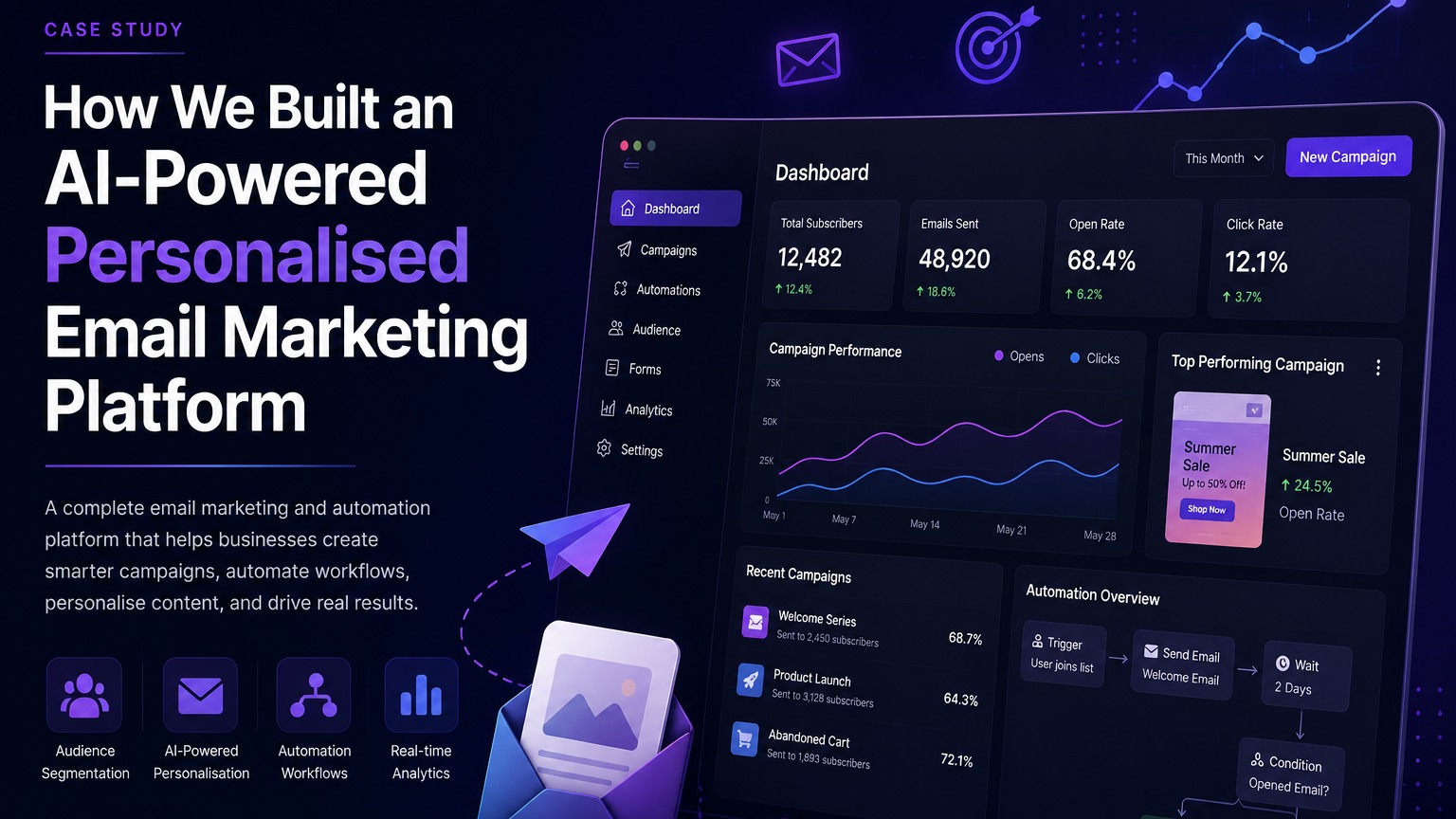
How We Built an AI Powered Personalised Email Marketing Platform
Email Marketing | Personalisation | Automation | Next.js | FastAPI | Azure OpenAI | Recommendation Systems
Email marketing is still one of the most effective ways for businesses to communicate with their customers. But as audiences grow, creating relevant campaigns, managing subscribers, personalising content, and maintaining consistent engagement becomes increasingly difficult.
Sending the same message to everyone is easy.
Sending the right message to the right person at the right time is much harder.
At EttaDev, we built an AI-powered personalised email marketing platform designed to make email campaigns more intelligent, automated, and relevant.
The platform combines email campaign management, audience segmentation, workflow automation, AI-powered content personalisation, and analytics into a single workspace.
The goal was not simply to build another email marketing dashboard.
The goal was to create a system capable of helping businesses understand their audiences, personalise communication, automate repetitive marketing workflows, and reduce irrelevant email content.
The platform uses a decoupled architecture with Next.js, FastAPI, RocksDB, and Azure OpenAI, creating a foundation for scalable email marketing and AI-powered personalisation.
The Challenge: Personalised Email at Scale
Email marketing becomes complicated as soon as the audience starts growing.
A small business may initially manage campaigns manually.
Create an email.
Choose a list.
Send it.
But once the audience contains thousands of contacts with different interests, behaviours, locations, and engagement patterns, a single generic campaign becomes much less effective.
Marketing teams need to answer questions such as:
-
Which contacts should receive this campaign?
-
What content is most relevant to each subscriber?
-
Which users are actively engaged?
-
Who has become inactive?
-
When should an email be sent?
-
Which users should enter an automated sequence?
-
How can content be personalised without manually creating hundreds of versions?
Traditional email marketing platforms provide many of these capabilities, but building a system around intelligent personalisation and automated decision making requires a different architecture.
The project needed to combine conventional email marketing functionality with AI driven workflows without making the experience unnecessarily complicated for marketers.
The Solution: An Intelligent Email Marketing Workspace
We designed the platform as a complete email marketing workspace where businesses can manage their campaigns, contacts, automations, forms, sender identities, and marketing workflows.
The platform brings together several core capabilities:
Campaigns → Audiences → Personalisation → Automation → Analytics
Instead of treating email marketing as simply sending messages, the system treats it as a continuous workflow.
A marketer can create a campaign, select an audience, personalise its content, schedule delivery, monitor engagement, and use those interactions to influence future communication.
This creates a much more connected marketing workflow.
Building the Email Campaign Engine
Campaign management is one of the core parts of the platform.
The system allows marketers to create email campaigns through a visual editor or HTML based editing workflow. Campaign creation follows a structured process covering the audience, content, and final review before delivery.
Campaigns can be:
-
Sent immediately
-
Scheduled for a specific time
-
Targeted toward selected audiences
-
Personalised for individual recipients
-
Tracked through campaign analytics
The analytics layer provides visibility into metrics such as:
-
Open rates
-
Click rates
-
Bounces
-
Recipient activity
-
Individual recipient timelines
This gives marketing teams a clearer picture of how their campaigns perform instead of relying purely on delivery counts.
AI-Powered Personalisation
Personalisation was one of the most important aspects of the platform.
Traditional email personalisation often means inserting simple variables such as:
Hi {{first_name}}
That is useful, but it is only the beginning.
Modern personalisation can go much further.
An AI-powered system can use available customer information and campaign context to help generate messaging that feels more relevant to the individual recipient.
The platform was designed around this idea.
Instead of treating every subscriber as identical, the system can work with audience information and behavioural data to support more personalised communication.
This is where Azure OpenAI becomes part of the application architecture.
The LLM layer provides the intelligence required for generating or transforming content while the surrounding application controls the marketing workflow, audience data, and delivery process.
The result is not simply an AI writing tool.
It is an email marketing system where AI becomes part of the campaign workflow.
Recommendation Systems for Better Email Content
Personalisation becomes significantly more powerful when it is connected to recommendation logic.
A recommendation system can help determine what type of content may be more relevant to a particular user based on available information and behaviour.
For example, different subscribers may have completely different interests.
A user who regularly interacts with product updates should not necessarily receive the same content as someone primarily interested in educational material.
The platform was designed to support this type of personalised marketing workflow.
Instead of relying entirely on manually created rules, recommendation logic can help move the system toward more dynamic content selection.
This creates a feedback loop:
User Data → Segmentation → Recommendation → Personalised Content → Engagement → More Data
Over time, this type of architecture can help marketing systems become more responsive to audience behaviour.
Building Automated Email Workflows
Email marketing becomes much more powerful when repetitive tasks can be automated.
The platform includes a visual automation builder that allows marketers to create multi-step email workflows.
Automations can be triggered by events such as:
-
A user joining a list
-
An abandoned cart
-
Inactivity
-
A purchase
-
Previous email engagement
The workflow can then introduce:
Triggers → Conditions → Delays → Actions
For example:
A customer joins a newsletter.
↓
The system sends a welcome email.
↓
The customer opens the email.
↓
The workflow waits several days.
↓
A follow-up message is sent.
↓
The next action depends on the customer's behaviour.
This type of workflow removes repetitive manual work from marketing teams while allowing communication to respond to actual customer behaviour.
Audience Segmentation
Personalisation is only useful when the system understands its audience.
The platform provides contact management, lists, dynamic segments, and tags to help marketers organise subscribers.
Contacts can contain information such as:
-
Country
-
Company
-
Consent date
-
Engagement information
-
Tags
-
List membership
Segments can be created using logical conditions, including AND and OR rules.
This makes it possible to create targeted audiences instead of repeatedly sending campaigns to an entire database.
For example, a marketing team could create segments for:
Active Customers
New Leads
Inactive Subscribers
High Value Customers
Newsletter Subscribers
Recently Purchased Users
The segmentation layer becomes the foundation for more relevant campaign delivery.
Lead Generation and Forms
The platform is not limited to sending emails.
It also includes tools for growing the audience.
Marketers can create forms for:
-
Newsletters
-
Waitlists
-
Lead magnets
Forms can be customised to match the brand's visual identity, including primary colours, background colours, and border radius settings.
The platform also supports double opt-in flows, helping businesses implement a more controlled and consent-focused subscriber acquisition process.
This creates a complete acquisition-to-engagement workflow:
Visitor → Lead Form → Subscriber → Segmentation → Campaign → Automation → Engagement
Multi-Tenant Architecture for Multiple Brands
The platform was designed with businesses and teams in mind.
Its workspace architecture supports multiple brands within a multi-tenant environment.
This allows users to manage different workspaces while maintaining separation between their marketing environments.
Role-based permissions are also supported, including:
-
Owner
-
Admin
-
Marketer
This becomes particularly important when multiple people are working on campaigns and customer data.
A marketing platform should not only provide powerful features.
It also needs to provide appropriate access control around those features.
Sender Domains and Email Infrastructure
Email marketing depends heavily on delivery infrastructure.
The platform provides sender identity and domain management, including DNS verification for custom sending domains.
It can also connect with external SMTP providers such as:
-
SendGrid
-
Mailgun
-
Amazon SES
This approach allows the application to remain flexible around email delivery infrastructure instead of forcing every customer into a single provider.
That separation is particularly valuable when building a SaaS email marketing platform intended to support different business requirements.
The Technology Behind the Platform
The platform uses a modern web stack designed around performance, maintainability, and scalability.
Next.js
Next.js provides the application foundation and user interface.
The platform uses the Next.js App Router to build the marketing workspace and its different application experiences.
TypeScript
TypeScript provides type safety throughout the application.
For a system involving campaigns, contacts, automation workflows, permissions, and integrations, strong typing helps keep the application maintainable as complexity increases.
Prisma
Prisma acts as the database ORM and provides the application with a structured way to work with the underlying database.
PostgreSQL
PostgreSQL provides the primary relational database layer.
This is particularly well suited to a platform containing structured entities such as users, contacts, campaigns, automations, segments, workspaces, and permissions.
Authentication and Workspace Security
The platform uses custom JWT and session management for authentication.
Combined with role-based permissions and workspace isolation, this provides the foundation for a multi-user SaaS environment.
Designing for a Premium SaaS Experience
The technical architecture was only one part of the project.
The product also needed to feel like a modern SaaS application.
The interface follows a premium dark-mode design system with elevated surfaces, vibrant indigo and violet accents, subtle glassmorphism, and interactive UI states.
The goal was to make complex marketing functionality feel approachable.
Automation builders can become complicated quickly.
Audience segmentation can become complicated.
Analytics can become complicated.
The interface therefore needed to keep the workflows visually understandable while still providing the depth required by professional marketing teams.
From Email Sending to Intelligent Marketing
The biggest idea behind the project was moving beyond basic email delivery.
A traditional workflow looks like:
Create Email → Select List → Send
A more intelligent marketing workflow looks like:
Collect Data → Understand Audience → Segment Users → Personalise Content → Automate Delivery → Measure Engagement → Improve Future Campaigns
That difference is significant.
Email becomes part of a continuous data-driven system rather than an isolated marketing activity.
This is where AI, automation, recommendation systems, and conventional email marketing infrastructure come together.
What We Built
The resulting platform brings together the major components required for modern email marketing:
Campaign Management
Visual email creation, HTML editing, scheduling, and campaign analytics.
Marketing Automation
Visual workflow creation with triggers, conditions, delays, and behavioural actions.
Audience Management
Contact profiles, lists, dynamic segments, and tags.
Lead Generation
Custom forms for newsletters, waitlists, and lead magnets with double opt-in support.
Personalisation
AI-assisted content workflows designed around more relevant communication.
Recommendation Logic
Data-driven approaches for improving content relevance and user targeting.
Workspace Management
Multi-tenant workspaces and granular roles for teams and multiple brands.
Email Infrastructure
Custom sender identities, domain verification, and SMTP provider integrations.
All of these capabilities work together inside a single marketing platform.
The Impact
The platform demonstrates how traditional SaaS development and AI engineering can be combined into a practical marketing product.
Instead of building an isolated AI writing tool, we built the surrounding infrastructure required to make AI useful inside a real marketing workflow.
The result is a platform focused on:
Personalisation
More relevant email communication based on audience information and marketing context.
Automation
Reducing repetitive campaign and customer communication workflows.
Segmentation
Helping marketers target specific groups instead of treating every subscriber the same.
Analytics
Giving teams visibility into engagement and recipient behaviour.
Scalability
Providing a multi-tenant architecture capable of supporting multiple workspaces and brands.
Flexible Infrastructure
Supporting custom sender identities and external SMTP providers.
What This Project Demonstrates
Modern email marketing is becoming increasingly data-driven.
The most effective platforms are no longer just tools for creating newsletters.
They are becoming intelligent systems that combine:
Customer Data + Automation + AI + Personalisation + Analytics
The AI-powered personalised email platform demonstrates how these technologies can work together to create a more complete marketing workflow.
The important part is not simply adding an LLM to an email editor.
It is designing the entire product around how marketers actually work.
That means building the audience infrastructure, automation engine, analytics, permissions, email delivery integrations, and AI capabilities as one connected system.
Building AI-Powered Marketing Software
At EttaDev, we build custom software products around real business requirements.
That includes SaaS platforms, AI integrations, intelligent automation, custom web applications, and data-driven systems.
This project is a good example of that approach.
The challenge was not simply:
"How do we generate an email with AI?"
The more important question was:
"How can AI become part of a complete marketing system?"
That required combining application engineering, database architecture, automation workflows, email infrastructure, audience management, and AI-powered personalisation.
The result is a product designed around the complete marketing lifecycle rather than a single AI feature.
Conclusion
Building a modern email marketing platform requires much more than an email editor.
Businesses need campaign management, audience segmentation, automation, analytics, lead generation, email infrastructure, permissions, and increasingly, intelligent personalisation.
With this project, EttaDev brought those capabilities together into a modern SaaS workspace powered by Next.js, TypeScript, Prisma, PostgreSQL, FastAPI, RocksDB, and Azure OpenAI.
The platform is designed to help businesses move from generic email campaigns toward more personalised, automated, and data-driven communication.
Because the future of email marketing is not about sending more emails.
It is about sending more relevant emails to the right people at the right time.
Frequently Asked Questions
What is an AI-powered email marketing platform?
An AI-powered email marketing platform combines traditional campaign management and marketing automation with artificial intelligence to support personalised content, audience targeting, recommendations, and automated workflows.
What features does the EttaDev email marketing platform provide?
The platform includes email campaigns, visual email creation, scheduling, campaign analytics, automated workflows, audience segmentation, contact management, tags, lead-generation forms, workspaces, role-based permissions, sender domain management, and SMTP integrations.
How does AI improve email personalisation?
AI can help analyse available audience and campaign context and generate or transform content for more relevant communication. In a larger marketing workflow, this can work alongside segmentation, recommendation logic, automation, and engagement data.
What is email marketing automation?
Email marketing automation allows businesses to create workflows that automatically respond to events or customer behaviour. These workflows can include triggers, conditions, delays, and follow-up actions.
What is audience segmentation in email marketing?
Audience segmentation is the process of dividing subscribers into groups based on attributes, behaviour, engagement, or other criteria. The platform supports lists, dynamic segments, logical conditions, and tags for organising audiences.
Can the platform support multiple brands?
Yes. The platform uses a multi-tenant workspace architecture that allows users to manage multiple brands, with roles including Owner, Admin, and Marketer.
Which technologies were used to build the platform?
The README identifies Next.js 15, TypeScript, Tailwind CSS, Prisma, PostgreSQL through Supabase, custom JWT/session management, Lucide React, and shadcn/ui as core technologies.
Can EttaDev build a custom AI email marketing platform?
Yes. EttaDev builds custom SaaS products, AI integrations, automation systems, and business software tailored around specific workflows and requirements. (ettadev.com)