The Next Frontier: AI Agents and Autonomous Systems

Hamza
September 4, 2026
AI agents are moving beyond simple prompts and chatbots. Explore how autonomous AI systems use reasoning, tools, memory, and workflows to automate complex business processes.
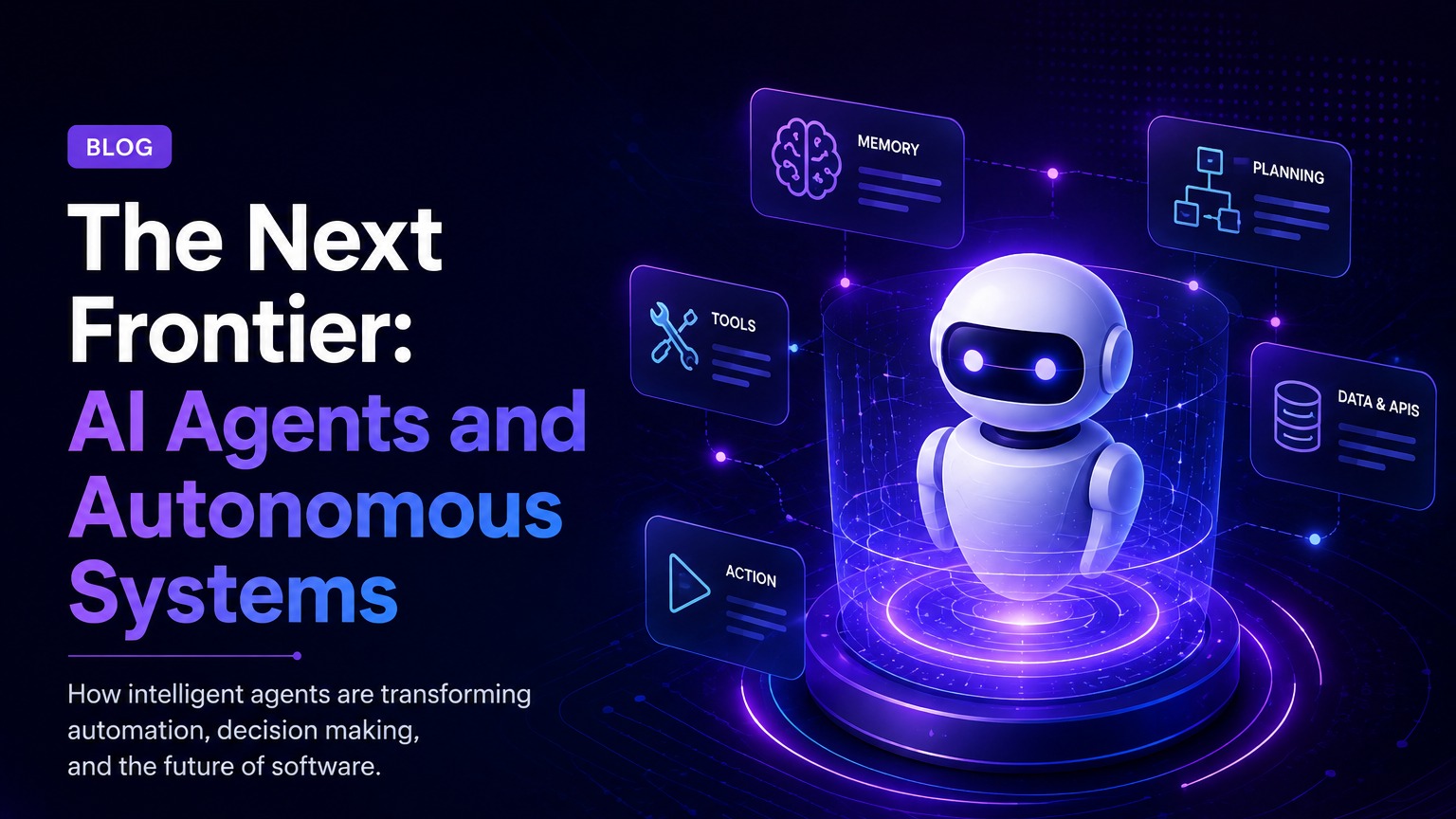
The Next Frontier: AI Agents and Autonomous Systems
AI Agents | Autonomous Systems | Generative AI | LLMs | AI Automation | Agentic AI | Machine Learning
Artificial intelligence is moving beyond systems that simply respond to prompts.
The next stage is about systems that can understand objectives, reason through problems, use tools, make decisions, and execute tasks with limited human intervention.
This shift is driving the rise of AI agents and autonomous systems.
At EttaDev, we see AI agents as more than another layer on top of existing software. They represent a different way of building applications, where intelligent systems can participate directly in business workflows and continuously act on information.
Instead of asking AI to generate a response and then manually deciding what to do next, an agent can potentially understand the objective, determine the required steps, interact with external systems, evaluate the results, and continue until the task is completed.
That changes what software can do.
From AI Assistants to AI Agents
Traditional AI applications generally follow a simple pattern:
User Input → AI Model → Response
The user asks a question, the model generates an answer, and the user decides what happens next.
AI agents introduce another layer of intelligence:
Goal → Reasoning → Planning → Tool Use → Action → Evaluation → Result
An AI agent can be designed to work toward a specific objective rather than simply respond to an individual prompt.
For example, instead of asking an AI assistant:
"Summarise these customer complaints."
An agent could be given a broader objective:
"Analyse this month's customer complaints, identify recurring issues, classify their severity, compare them with previous months, and prepare a report for the support team."
The difference is important.
The first workflow requires a human to orchestrate the process.
The second allows an AI agent to participate in the orchestration itself.
What Is an AI Agent?
An AI agent is a software system that combines an AI model with additional capabilities that allow it to reason, access information, use tools, and perform actions.
A practical AI agent architecture may include:
-
A large language model
-
Memory and conversation state
-
Retrieval systems
-
External tools and APIs
-
Planning mechanisms
-
Decision logic
-
Workflow execution
-
Observability and monitoring
-
Safety and permission controls
The language model provides reasoning and language capabilities, but the surrounding system determines what the agent can actually do.
This distinction is critical.
An LLM by itself generates information.
An AI agent can use that information to take action.
Why AI Agents Are Becoming Important
Businesses already use software to automate repetitive tasks.
Traditional automation typically follows predefined rules.
For example:
If a customer submits a form → create a CRM record → send an email.
This works well when the workflow is predictable.
But many real business processes are not predictable.
Customer requests vary.
Documents contain different information.
Research questions change.
Business decisions often require context.
This is where AI agents can provide another layer of flexibility.
An agent can interpret an objective, determine which information is relevant, select appropriate tools, and adapt its workflow based on the results.
Instead of automating only individual actions, businesses can begin automating entire knowledge workflows.
The Architecture Behind an AI Agent
Building a reliable AI agent requires considerably more than connecting an application to an LLM API.
A typical agent architecture can contain several interconnected components.
Large Language Model
The LLM provides the reasoning and language capabilities of the system.
Models can interpret instructions, analyse information, generate structured outputs, and determine which actions may be appropriate.
The model might be powered by technologies such as OpenAI models, Azure OpenAI, Anthropic models, or other foundation models depending on the application's requirements.
Memory
Agents often need access to previous information.
Memory can allow an agent to maintain context across a conversation, workflow, or task.
Depending on the application, memory may include:
-
Conversation history
-
User preferences
-
Previous actions
-
Retrieved information
-
Task state
-
Business context
Retrieval
Agents frequently need information that does not exist inside the model's training data.
Retrieval Augmented Generation, commonly known as RAG, allows agents to retrieve relevant information from external sources.
These sources can include:
-
Internal documents
-
Databases
-
Knowledge bases
-
APIs
-
Websites
-
Customer records
-
Business systems
This makes the agent more useful in real-world environments.
Tools
Tools allow an agent to interact with external systems.
For example, an AI agent could have access to:
-
Search APIs
-
Databases
-
CRM systems
-
Email services
-
Calendar APIs
-
Financial systems
-
Internal business APIs
-
Document processing services
-
Analytics platforms
Tools transform an AI system from something that only generates text into something capable of interacting with software.
Planning and Reasoning
Complex tasks often require multiple steps.
An agent may need to determine:
-
What information is required?
-
Which tools should be used?
-
What should happen first?
-
What information is missing?
-
Did the previous action succeed?
-
What should happen next?
This planning layer is one of the fundamental differences between simple AI applications and agentic systems.
AI Agents and RAG
Retrieval Augmented Generation has become one of the most important architectures for enterprise AI applications.
RAG allows an AI system to retrieve relevant information before generating a response.
For an AI agent, retrieval can become part of a larger decision-making workflow.
For example:
User Question → Understand Intent → Search Knowledge Base → Retrieve Relevant Documents → Analyse Results → Generate Answer
A more advanced agentic workflow could continue:
Generate Answer → Verify Information → Search for Missing Context → Refine Result → Return Final Response
This approach can be particularly useful for applications involving large amounts of internal knowledge.
Examples include:
-
AI document research
-
Enterprise knowledge assistants
-
Legal document analysis
-
Customer support
-
Technical documentation
-
Financial research
-
Internal business intelligence
The combination of AI agents and RAG creates systems capable of reasoning over organisation-specific information rather than relying exclusively on general-purpose model knowledge.
Multi-Agent Systems
A single AI agent can handle many workflows.
However, some complex problems can benefit from multiple specialised agents.
Instead of creating one agent responsible for everything, a system can divide responsibilities between specialised agents.
For example:
Research Agent
Finds and retrieves relevant information.
Analysis Agent
Processes and evaluates the information.
Data Agent
Queries databases and structured sources.
Writing Agent
Creates the final report.
Review Agent
Checks the output for errors, missing information, or inconsistencies.
These agents can work together through an orchestration layer.
A simplified workflow could look like:
User Goal → Planner Agent → Research Agent → Analysis Agent → Review Agent → Final Output
This architecture can make complex AI workflows easier to reason about and maintain.
Autonomous Systems
AI agents are one part of a much larger movement toward autonomous software.
An autonomous system is designed to operate with reduced human intervention while continuously responding to its environment.
Consider a traditional monitoring system.
It may detect an issue and notify an engineer.
An autonomous system could potentially:
Detect → Analyse → Determine Cause → Execute Remediation → Verify → Report
This concept can be applied across many industries.
Software Engineering
Agents can analyse errors, inspect logs, identify potential causes, generate patches, and run tests.
Customer Support
Agents can understand customer requests, retrieve account information, determine the appropriate response, and execute approved actions.
Business Operations
Agents can monitor workflows, identify anomalies, update records, and trigger operational processes.
Research
Agents can search multiple sources, compare information, analyse findings, and produce structured reports.
Marketing
Agents can analyse campaign performance, identify trends, generate recommendations, and support campaign optimisation.
The common principle is simple:
Software does not only provide information. It can increasingly participate in the work itself.
The Role of APIs and Tools
One of the most important components of agentic software is tool integration.
An AI agent becomes significantly more capable when it can interact with external systems.
Imagine an AI sales agent with access to:
CRM + Email + Calendar + Analytics + Product Database
A salesperson could provide a goal such as:
"Prepare follow-ups for our highest-value leads from this week."
The agent could:
-
Query the CRM.
-
Identify high-value leads.
-
Review previous interactions.
-
Analyse customer context.
-
Generate personalised follow-up messages.
-
Schedule approved emails.
-
Record the activity in the CRM.
The AI model provides reasoning.
The APIs provide capabilities.
The application provides the rules and boundaries.
Together, they create an agentic workflow.
Human in the Loop
Autonomous does not necessarily mean completely independent.
For many business applications, the most effective architecture will combine automation with human approval.
A workflow might look like:
AI Agent → Analyse → Recommend → Human Approval → Execute
For example, an AI agent could prepare a financial report but require a human to approve it before distribution.
A customer support agent could draft a response and automatically handle low-risk requests while escalating sensitive cases.
A software engineering agent could generate a code change and require review before merging it.
This approach provides a balance between automation, control, and accountability.
The Importance of Guardrails
Giving an AI system the ability to take actions introduces new engineering challenges.
An agent should not automatically have unrestricted access to every system.
A reliable agentic architecture should define:
-
Which tools the agent can access
-
Which actions require approval
-
What information the agent can access
-
What data can be modified
-
How errors are handled
-
When the workflow must stop
-
How actions are logged
-
How outputs are evaluated
Permissions become especially important when agents interact with production systems, customer data, financial information, or sensitive business workflows.
AI autonomy needs to be paired with strong software engineering.
Observability and Evaluation
Traditional applications can often be debugged by following deterministic code paths.
AI systems introduce probabilistic behaviour.
The same prompt may not always produce exactly the same output.
Agentic applications make observability even more important.
Engineering teams need visibility into:
-
Agent decisions
-
Tool calls
-
Retrieved information
-
Model outputs
-
Execution time
-
Failed actions
-
Token usage
-
Workflow state
-
Human approvals
Evaluation also becomes an important part of development.
An AI agent should not simply be tested on whether the application runs.
It should be evaluated on whether it:
-
Retrieves the right information
-
Selects appropriate tools
-
Follows instructions
-
Produces accurate results
-
Handles unexpected situations
-
Avoids unauthorised actions
-
Completes tasks successfully
Reliable AI agents require continuous testing and monitoring.
Building Agentic Systems with Modern AI Technology
Modern AI engineering provides a growing ecosystem for building agentic applications.
Frameworks such as LangChain and other orchestration technologies can help developers connect language models with tools, retrieval systems, memory, and workflows.
A modern architecture might combine:
Next.js
For the user interface and application experience.
FastAPI
For high-performance Python services and AI workflows.
LLMs
For reasoning, generation, classification, and decision support.
RAG
For retrieving application-specific knowledge.
Vector Databases
For semantic search and knowledge retrieval.
LangChain
For connecting models, tools, retrieval, and agent workflows.
PostgreSQL
For structured application and business data.
Redis
For caching, queues, sessions, and real-time application workloads.
The exact stack depends on the use case.
The important part is designing the architecture around the business workflow rather than selecting technologies simply because they are popular.
AI Agents Are Not Just Chatbots
One of the biggest misconceptions about AI agents is that they are simply advanced chatbots.
A chatbot primarily focuses on conversation.
An AI agent focuses on achieving an objective.
A chatbot might answer:
"What are our sales numbers this month?"
An agent could potentially:
-
Retrieve the latest sales data.
-
Compare it with previous periods.
-
Identify unusual changes.
-
Analyse contributing factors.
-
Generate a report.
-
Send the report to the appropriate team.
The interface might still look like a chat.
But underneath the interface is a completely different software architecture.
The intelligence is connected to tools, data, workflows, and actions.
Where AI Agents Can Create Real Business Value
The strongest applications of AI agents are not necessarily the most impressive demos.
They are the systems that solve expensive, repetitive, or complex business problems.
AI agents can support:
Research Automation
Automate information gathering, source analysis, summarisation, and report generation.
Customer Support
Classify requests, retrieve customer information, generate responses, and escalate complex cases.
Sales Operations
Research prospects, update CRM records, prepare follow-ups, and support sales teams.
Marketing Automation
Analyse audiences, personalise content, monitor campaigns, and support marketing workflows.
Data Analysis
Query datasets, identify patterns, generate reports, and explain business metrics.
Document Intelligence
Process large collections of documents and provide grounded answers based on their contents.
Internal Knowledge Management
Give employees intelligent access to company information across documents, databases, and internal systems.
The objective should always be measurable business value.
The Shift From Automation to Autonomy
Traditional automation focuses on predefined workflows.
Rule → Action
AI-powered automation adds intelligence.
Data → AI Decision → Action
Agentic systems take this further.
Goal → Reasoning → Planning → Tools → Actions → Evaluation → Adaptation
This does not mean every workflow needs to become autonomous.
In many cases, traditional automation will remain faster, cheaper, and more reliable.
The opportunity exists where workflows involve ambiguity, large amounts of information, decision-making, or frequent changes.
That is where AI agents can provide significant value.
What Comes Next?
The future of AI is unlikely to be defined by a single model.
It will be defined by how models are connected to software, data, tools, and business processes.
We are moving toward applications where AI is not simply a feature inside the product.
AI becomes part of the application's operating layer.
Instead of:
Software + AI Feature
we increasingly see:
Software + Data + AI + Tools + Automation + Human Oversight
This creates a new generation of intelligent applications capable of supporting increasingly complex workflows.
The next frontier is not simply generating better answers.
It is building systems that can understand objectives, reason about problems, use the right tools, take appropriate actions, and continuously improve the way work gets done.
Building AI Agents at EttaDev
At EttaDev, we build custom AI software and intelligent automation systems around real business requirements.
Our approach is focused on connecting AI with the infrastructure businesses already depend on.
That can include:
-
AI agents
-
RAG systems
-
LLM integrations
-
AI automation
-
Intelligent document processing
-
Custom SaaS platforms
-
Machine learning systems
-
API integrations
-
Data processing pipelines
-
Business workflow automation
The goal is not to add AI simply because AI is popular.
The goal is to identify where intelligent software can create measurable improvements in productivity, decision-making, automation, customer experience, and operational efficiency.
Conclusion
AI agents represent an important shift in software development.
The first generation of AI applications focused heavily on generating content and answering questions.
The next generation is moving toward systems that can reason, retrieve, plan, use tools, execute workflows, and operate with increasing levels of autonomy.
Building these systems successfully requires more than an LLM.
It requires thoughtful architecture, reliable data pipelines, retrieval systems, API integrations, workflow orchestration, permissions, observability, evaluation, and human oversight.
The real opportunity lies in connecting these technologies to meaningful business problems.
AI agents are not simply another type of chatbot.
They are a new approach to building software where intelligence can become an active participant in how work gets done.
And that may be the next major frontier of software engineering.
Frequently Asked Questions
What are AI agents?
AI agents are software systems that use artificial intelligence to understand objectives, reason about tasks, access information, use tools, and perform actions with varying levels of human supervision.
What is the difference between an AI agent and a chatbot?
A chatbot primarily focuses on responding to user messages. An AI agent is designed around completing objectives and can use tools, retrieve information, make decisions, and execute multi-step workflows.
What is Agentic AI?
Agentic AI refers to AI systems designed to operate toward goals by reasoning, planning, using tools, and taking actions rather than only generating a single response.
How does RAG work with AI agents?
RAG allows an AI agent to retrieve relevant information from external sources before generating an answer or making a decision. This can provide agents with access to company documents, databases, knowledge bases, and other application-specific information.
Can AI agents automate business workflows?
Yes. AI agents can support workflows involving research, customer support, sales operations, marketing automation, document processing, data analysis, and other knowledge-intensive processes.
Are AI agents completely autonomous?
Not necessarily. Many production systems use human-in-the-loop workflows where agents can perform low-risk actions automatically while requiring human approval for sensitive or high-impact decisions.
What technologies are used to build AI agents?
AI agent systems can use LLMs, RAG, vector databases, APIs, workflow orchestration frameworks, Python services, Next.js, FastAPI, PostgreSQL, Redis, and other technologies depending on the application's requirements.
Can EttaDev build a custom AI agent?
Yes. EttaDev develops custom AI applications, AI agents, RAG systems, intelligent automation workflows, SaaS platforms, and integrations designed around specific business requirements.